AI is useful for the repetitive parts of a job search: expanding titles, comparing postings, finding missing evidence in a resume, drafting a short note, and asking mock-interview questions. It is not a substitute for checking whether a job exists, whether you are eligible, or whether a sentence is true.
TL;DR
- Give AI your target role, location, salary, work arrangement, experience, and constraints before asking for recommendations.
- Verify every opening on the employer’s careers page or a reputable job board. A generated list is not a live vacancy list.
- Use real metrics and
[ADD DETAIL]placeholders. Never let a model invent dates, titles, employers, or achievements. - Remove sensitive information before uploading a resume. Do not share government IDs, references’ contact details, confidential work, or NDA material.
- Check an employer’s AI rules before assessments. Formatting and brainstorming are different from using AI during a test or inventing experience.
1. Define the search before using a model
Write a short brief: target roles, adjacent roles you would accept, location or country, salary floor, remote or hybrid preference, work authorization, notice period, seniority, industries to avoid, and evidence you can show. Ask AI to expand the titles and explain trade-offs, not to choose your life for you.
Example prompt:
I am a backend engineer with 4 years of Python, Postgres, and AWS experience.
I want roles in India or remote roles that explicitly accept candidates in India.
Salary floor: [ADD DETAIL]. Notice period: [ADD DETAIL].
Suggest adjacent titles and the evidence each title would expect. Mark assumptions.
Do not invent employers or live openings.
Then verify each employer, location, compensation statement, and closing date. Monster, Purdue Global, and Goodwill all describe AI as useful for discovery and filtering while warning candidates to review the output.
2. Build a target-employer list
Ask for a list by constraints, then research each company yourself. Check the official careers page, recent product or company news, employee location, and whether the role is open to your country. A remote label can still mean one country, a timezone window, or contractor-only work.
A good target list has a reason for inclusion: a matching problem, a relevant team, a public project, or a role that fits your evidence. It should not be a list of famous employers generated from generic keywords.
3. Tailor the resume without fabrication
Give the model raw notes rather than only a polished resume: project decisions, tools, scope, constraints, launch dates, dashboards, and outcomes. Ask it to extract missing evidence and flag gaps.
Generic: “Improved customer satisfaction.”
Truthful rewrite: “Reworked help-centre routing in Zendesk for 3 support queues; first-response time fell from 18 to 11 hours over the next quarter.”
Only use the rewrite if the numbers and time period are yours. If the model cannot find a metric, it should write [ADD DETAIL], not guess. Use the ATS resume template and resume keywords guide for structure, then rewrite the most important bullets yourself so they contain your decisions and trade-offs.
4. Use AI for networking, not impersonation
AI can summarize a public company page and draft a concise message. You must verify the person’s name, role, product details, and relationship. Send something you would genuinely say. Do not create false familiarity, mass-personalize unsupported claims, or scrape private contact information.
Keep the note specific: one observed project, one relevant piece of evidence, and one low-pressure question. If a person has not invited contact, respect platform rules and opt-outs.
5. Practise interviews aloud
Give the model the job description and your actual experience. Ask one question at a time, request follow-ups when your answer is vague, and practise out loud. Rehearse truthful stories about a result, conflict, failure, and difficult decision. Ask for critique of structure and missing evidence, not a perfect script.
Prompt:
Interview me for this role one question at a time.
Use only the experience in my notes. Ask follow-ups when I make a vague claim.
After each answer, identify one unclear point and one useful detail to add.
Do not write an achievement I did not provide.
The Associated Press notes that acceptable AI use can include formatting, explanation, and brainstorming, while using AI during assessments or inventing achievements may be inappropriate. Check the employer’s instructions.
Privacy and scam checks
Remove addresses, government identification numbers, birth dates, references’ personal details, and confidential employer information before using a public tool. Goodwill specifically warns that AI can invent dates, titles, and numbers. Keep the original document locally and review every output.
For a job found through AI, verify the opening on the employer’s domain. Never pay for an application, equipment, training, or a promised paycheck. Be cautious with unexpected text-based recruiters, requests to move to messaging apps, checks to deposit, and requests for bank details before a legitimate offer process.
A weekly system
Monday: scan and verify roles. Tuesday: tailor one or two applications. Wednesday: research a target employer and send a real note. Thursday: practise the next interview. Friday: record which sources produced legitimate conversations. The goal is not maximum applications; it is a traceable loop with fewer false positives and better evidence.
Keep a human checkpoint before every irreversible action: submitting an application, sending a message, uploading a portfolio, or completing an assessment. AI can compare options quickly, but you remain responsible for the claim, the recipient, and the employer’s rules.
Use an evidence ledger
AI makes it easy to produce a polished answer before you have checked the premise. Keep a small ledger for every serious application:
| Item | Record |
|---|---|
| Role source | URL, employer, date seen, and whether it is still open |
| Eligibility | Country, timezone, work authorization, employment model |
| Match | Two or three real experiences that support the requirements |
| Gaps | Requirements you cannot yet prove or need to learn |
| Claims | Metrics, dates, titles, and tools checked against your notes |
| Next action | Application, question for recruiter, or deliberate skip |
This ledger gives an AI assistant useful boundaries. It also protects you when a posting appears on several boards with different locations or salary language. If the employer page is gone, mark the role closed or unverified instead of asking a model to reconstruct it from search snippets.
An honest before-and-after review
Illustrative example, not a claim about a real candidate: The raw note says, “Improved customer satisfaction.” The candidate supplies the missing facts: Zendesk, three support queues, an 18-to-11-hour first-response change, and the following quarter. A model can suggest: “Reworked help-centre routing in Zendesk across three support queues, reducing first-response time from 18 to 11 hours over the next quarter.”
The candidate then checks that the change was actually theirs, that the period is correct, and that “reducing” does not imply causation beyond what the team measured. If one fact is missing, the draft should say [ADD DETAIL]. A smoother sentence is not a reason to accept an invented number. Use the same review for cover letters, application questions, and portfolio captions.
Country, role, and seniority branches
AI recommendations often flatten local hiring rules. For India, give it city or remote eligibility, notice period, work authorization, and whether compensation is expressed as CTC. For the EU and UK, include language requirements, right-to-work questions, and the employer’s data handling expectations. For a US role, check state or country eligibility and whether “remote” means remote within the US. For any country, ask the employer rather than assuming a model understands payroll or immigration.
The same prompt also needs a role branch. An engineer should provide repositories, architecture decisions, reliability work, and on-call scope. A marketer should provide audience, channel, experiment, and measured outcome. A fresher may use projects, coursework, internships, and a portfolio rather than pretending those are full-time employment. A career returner can ask AI to explain a gap and refresh skills, but should not let it create a role or achievement during the gap.
Scam and privacy gates
Before uploading a resume, remove home address, government identification numbers, birth date, references’ personal contact details, confidential source code, customer names covered by an NDA, and compensation information that is not needed for the task. Check the tool’s retention and training controls. Keep a local original and use a redacted copy for experimentation.
For every AI-surfaced job, verify the company domain, recruiter identity, and application route. Do not pay for an application, equipment, training, or a promised paycheck. Treat a check to deposit, a request to move immediately to an encrypted chat, an urgent request for bank details, or a task that requires forwarding money as a stop signal. A real employer can be contacted through a public company channel.
AI in assessments
Formatting a resume and practising a story are different from using AI during a take-home test. Read the instructions. If the employer permits assistance, keep a record of what you used and be able to explain the result. If the employer prohibits it, do not hide use behind a polished submission. Never use AI to claim a certification, language, degree, project, or production responsibility you cannot defend in a conversation.
The strongest workflow is deliberately slower at the boundary: AI expands possibilities, you choose a role, the employer page confirms it, your notes support the claims, and you make the final submission. That is leverage without outsourcing judgment.
The how to use ai to find a job operating standard
This guide is written for a reader who needs to use how to use ai to find a job in a real workflow, not merely understand the definition. The dependable version starts with the decision that must be made, names the evidence available today, and keeps the next step small enough to complete. That is the editorial standard used throughout this guide and across the Parlel library: practical guidance should help a founder, operator, candidate, or freelancer act without hiding uncertainty behind confident language.
Decide what success means before you start
Write the result in one sentence: “After this exercise, I will know whether , and the next action will be .” For how to use ai to find a job, that sentence prevents the most common failure mode — doing more research after the useful question has already been answered. If the work concerns a person, company, role, client, or vendor, record the source and date as you go. If it concerns a template or message, define the recipient, context, and desired response before polishing the wording.
Use a small fixture rather than an abstract example. Pick three to five real records, situations, or drafts and run the method end to end. Keep one case that should succeed, one ambiguous case, and one case that should be rejected. That mix exposes whether the process can distinguish a useful signal from a convenient story. It also gives you material for a later review without pretending that a tiny sample is a benchmark.
Make the work explainable to another person
A high-quality result should survive a handoff. Another person should be able to see what was known at the time, which assumptions were made, what action was taken, and what would change the decision. For this topic, preserve the original input alongside the conclusion. Keep a short “why now” note, the owner, the due date, and the stop condition. This makes how to use ai to find a job useful in an agency-style operating system: the work is repeatable without becoming mechanical, and a reviewer can improve it without rewriting the whole process.
Quality-control pass before you ship
- Intent: Does the page answer the query implied by its title in the first screen?
- Evidence: Are current facts linked to a source, date, or clearly labeled assumption?
- Specificity: Could a reader use the checklist, script, table, or example immediately?
- Boundaries: Does the guide say when the method is a poor fit or should stop?
- Next action: Is there one useful action rather than a pile of competing calls to action?
Those checks matter more than adding another paragraph of general advice. They also protect search quality: the page earns attention by resolving the reader's problem, not by repeating how to use ai to find a job unnaturally. If the evidence is thin, say so and explain how to improve it. If the answer changes by country, role, plan, or company size, make that branch visible instead of burying it in a footnote.
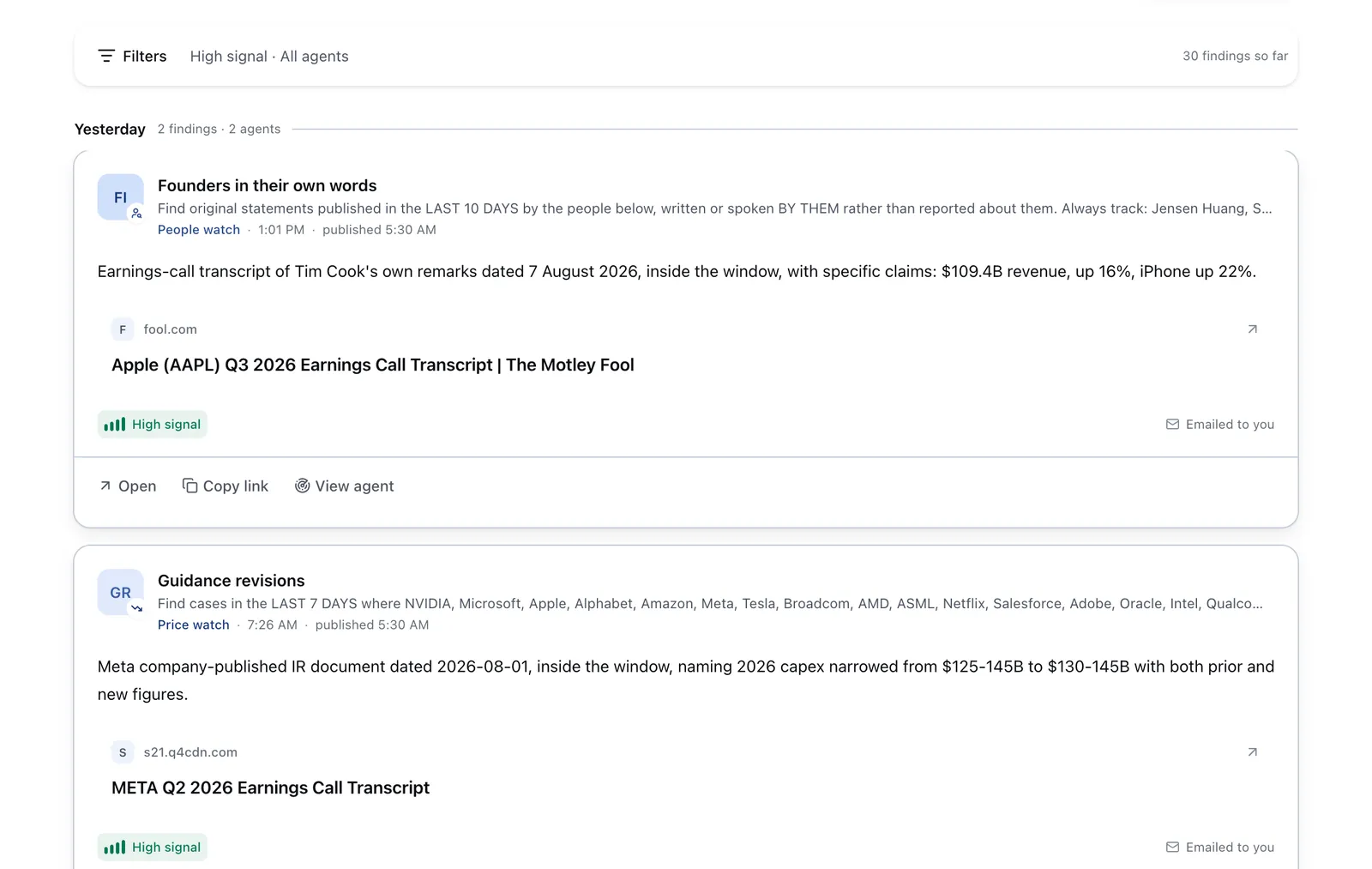
Run it on Parlel
Use a standing watch for roles that match your real constraints, then verify each result before applying.
agent: job_watch
keywords: backend, python, postgres
location: india_or_remote_eligible
seniority: mid
digest: monday_09:00_ist
fields: company, role, location_rule, posted_at, verification_step
Digest: matching open roles with location and freshness fields, not an automatic application. Review the job board, confirm the posting on the employer’s site, and tailor only when the evidence fits.
Keep reading
Continue the workflow with three closely related guides: - ats resume template - startup job boards - interview questions and answers
Frequently asked questions
How can AI help me find suitable jobs?
Give it your role, location, salary, arrangement, experience, and constraints. Use it to expand titles, identify adjacent paths, filter postings, and build an employer list. Verify every opening yourself.
Can AI write or improve my resume?
Yes. Use it to extract requirements, identify missing evidence, and clarify bullets. Supply real metrics and require placeholders for missing facts.
How do I avoid an AI resume sounding generic?
Add your decisions, tools, outcomes, constraints, and voice. Specific evidence is more useful than keyword stuffing; there is no secret keyword that guarantees an interview.
How can AI help with networking and applications?
Use it to research and draft, then fact-check names and claims and send a message you would genuinely say. Do not impersonate familiarity or automate unwanted contact.
How should I use AI for interview preparation?
Run a one-question-at-a-time mock interview based on the role and your experience. Practise aloud and require follow-ups on vague answers. Follow employer rules for assessments.