There is no universally suitable remote job board. A broad board provides volume; a curated or specialist board may make quality and eligibility easier to inspect. Direct employer pages and professional networks matter because many remote roles are duplicated, stale, or never syndicated.
TL;DR
- Use one broad source, one curated or niche source, and direct employer career pages.
- Remote does not mean worldwide. Check country, timezone, payroll, contractor status, and travel requirements.
- Digital-nomad jobs require explicit country or “work from anywhere” language, not a remote badge.
- India-based candidates should combine global filters with India-focused boards and employer pages.
- Never pay to apply, buy equipment, deposit a check, or send money back. Verify every employer.
15 boards and what to inspect
| Board | Best for | Check |
|---|---|---|
| We Work Remotely | Curated remote categories | Countries and post date |
| FlexJobs | Paid, vetted flexible work | Subscription and category fit |
| Remote OK | Remote tech volume | Actual eligibility and duplicates |
| Remote.co | Remote-company discovery | Employer and freshness |
| Wellfound | Startup remote roles | Equity, location, and payroll |
| Volume and network | Recruiter identity and reposts | |
| YC Jobs | Early-stage startup roles | Country and timezone |
| Working Nomads | Location-independent searches | Contractor terms and overlap |
| Remotive | Async-oriented community | Employer and job age |
| Jobspresso | Curated tech and creative roles | Location scope |
| Arc.dev | Vetted developers | Assessment and engagement model |
| Turing | Engineering matching | Tests, contract, and pay terms |
| Cutshort | India remote technology jobs | Local employment details |
| Upwork | Freelance and contract work | Client identity and payment protection |
| Direct employer pages | Source-of-truth openings | Whether the role remains open |
This is a use-case matrix, not a verified September 2026 volume ranking. Current comparison pages make publisher claims about curation, timestamps, and salary visibility, but the supplied evidence does not independently verify listing counts or response rates.
Choose the combination
For a software engineer, Remote OK or LinkedIn can provide volume, while We Work Remotely, Wellfound, or a direct careers page gives a more focused second pass. For support, marketing, or operations, We Work Remotely and Remote.co may be more relevant than developer-heavy aggregators. For a freelancer, Upwork or a contract-first route may be a better fit than a full-time board, but inspect client verification and payment protection.
For digital nomad jobs, search for “work from anywhere,” explicit country lists, contractor status, and required overlap. A remote job tied to US payroll is not automatically available from India, Portugal, or Bali. Ask about tax, entity, benefits, currency, payment fees, and travel expectations before the final stage.
Build a remote-search matrix
Remote is an employment condition, not a location. Track it as separate fields.
| Field | Questions to answer |
|---|---|
| Eligible country | Can you be hired where you live, or only visit temporarily? |
| Employer model | Employee, contractor, agency, or employer-of-record? |
| Timezone | Is overlap fixed, flexible, or described only as “global”? |
| Office cadence | Any retreats, client visits, or required city days? |
| Pay | Currency, payroll entity, fees, tax handling, and variable pay? |
| Work setup | Equipment, security, internet, and travel expectations? |
| Application route | Board form, employer ATS, referral, or recruiter? |
A role can be remote in the employer’s country and unavailable to you. Do not infer global eligibility from a badge, a distributed-team claim, or a salary shown in your currency. Save the exact wording and ask a precise question before investing in a portfolio exercise.
Illustrative three-board workflow
Illustrative example, not a conversion study: A React engineer in India uses a broad board for volume, a specialist remote board for a second pass, and direct company pages for verification. The broad search returns a role marked “remote”; the employer page says “remote within the US.” The candidate rejects it without applying. A second role lists India as eligible, asks for three hours of overlap with Central European Time, and names a contractor arrangement. The candidate records those constraints and asks about payment, tax documentation, and equipment before the final stage.
The board did its job by exposing the role. The company page did the job of establishing the current rule. This division is healthier than trying to make a board guarantee an employer’s policy.
Use-case branches
Software and data: Check stack, on-call, production access, overlap, and whether “remote” hides a country restriction. A take-home task should have a clear scope and an employer AI policy.
Support and customer success: Check shift coverage, language, weekend expectations, call setup, and whether the role is employee or contractor. “Async” does not mean no live customer hours.
Marketing and operations: Check the market served, travel, campaign or vendor ownership, and who can approve work. A remote label cannot clarify whether the job is truly location-independent.
Freelance and contract: Use client verification and platform payment protections where available. Confirm deliverables, acceptance, currency, fees, intellectual property, and termination terms before beginning work.
Digital nomad: Require explicit country or work-from-anywhere language, not merely “remote.” Ask how long you may work from a location, which entity contracts you, and who handles tax and insurance questions. Get professional advice for your situation.
For India-based freshers, show self-direction through an internship, project, open-source contribution, or shipped artifact, and verify whether an unpaid “remote internship” has real supervision and learning value. For EU and UK candidates, check right-to-work and payroll details. For US candidates, confirm state eligibility, benefits, and employment classification.
Deduplicate before applying
The same role may appear on a board, an aggregator, a social post, and the ATS. Use the employer URL, job title, location rule, and posting date as a comparison key. Keep the earliest trustworthy source for discovery and the employer page for status. Do not submit four applications because a role appears four times. A simple tracker with found_at, verified_at, last_seen, status, and next_action prevents duplicate effort.
Scam and privacy gates
The FTC warns that scammers impersonate real employers on legitimate platforms. Never pay to get a job, buy equipment, deposit a check, send money back, or share bank and identity information under urgent pressure. Verify the recruiter through a public company channel. Be suspicious of text-only offers, reshipping tasks, unrealistic pay for simple work, and an employer that refuses to name the employing entity.
Share only the resume and portfolio information needed for the stage. Remove government IDs, references’ personal contact details, confidential work, and unnecessary home-address data. A remote job search expands the number of jurisdictions involved; it does not reduce your need to protect personal information.
A weekly remote-search routine
Start with constraints, not volume. On the first pass, remove roles that fail your country, employment model, or timezone requirement. On the second pass, read the responsibilities and save two pieces of evidence you can use in an application. On the third, verify the employer page and decide whether the role merits a tailored resume, a referral request, or a deliberate skip.
Keep a short queue rather than an endless saved list. For each role, record why it fits, what is uncertain, when you last checked it, and the next action. If a board repeatedly produces unavailable or stale jobs, change the query or remove it from the rotation. A candidate’s attention is a resource; the largest listing count is not automatically the most useful source.
India and work-from-home jobs
India-based candidates should combine global remote filters with Cutshort, local startup sources, and employer career pages. Global roles may exclude India because of payroll, tax, labour-law, data, or timezone constraints. Local roles may use CTC, notice period, PF, ESI, or city-specific language. State your real timezone and office cadence. For fresher work-from-home roles, show self-direction through an internship, freelance project, open-source contribution, or shipped artifact.
How to check a remote employer
Verify the role on the company’s own domain. Confirm who employs you, where you can work, whether you are an employee or contractor, the overlap hours, pay currency, benefits, equipment policy, and travel. Search the interviewer and company independently. A legitimate platform does not guarantee a legitimate poster; the FTC specifically warns that scammers impersonate real employers on legitimate sites.
Red flags include unexpected recruiter texts, messaging-app-only interviews, requests for money, equipment payments, checks to deposit, requests to send money back, and urgent requests for bank or identity information. Stop and verify through a public company channel.
The remote job boards operating standard
This guide is written for a reader who needs to use remote job boards in a real workflow, not merely understand the definition. The dependable version starts with the decision that must be made, names the evidence available today, and keeps the next step small enough to complete. That is the editorial standard used throughout this guide and across the Parlel library: practical guidance should help a founder, operator, candidate, or freelancer act without hiding uncertainty behind confident language.
Decide what success means before you start
Write the result in one sentence: “After this exercise, I will know whether , and the next action will be .” For remote job boards, that sentence prevents the most common failure mode — doing more research after the useful question has already been answered. If the work concerns a person, company, role, client, or vendor, record the source and date as you go. If it concerns a template or message, define the recipient, context, and desired response before polishing the wording.
Use a small fixture rather than an abstract example. Pick three to five real records, situations, or drafts and run the method end to end. Keep one case that should succeed, one ambiguous case, and one case that should be rejected. That mix exposes whether the process can distinguish a useful signal from a convenient story. It also gives you material for a later review without pretending that a tiny sample is a benchmark.
Make the work explainable to another person
A high-quality result should survive a handoff. Another person should be able to see what was known at the time, which assumptions were made, what action was taken, and what would change the decision. For this topic, preserve the original input alongside the conclusion. Keep a short “why now” note, the owner, the due date, and the stop condition. This makes remote job boards useful in an agency-style operating system: the work is repeatable without becoming mechanical, and a reviewer can improve it without rewriting the whole process.
Quality-control pass before you ship
- Intent: Does the page answer the query implied by its title in the first screen?
- Evidence: Are current facts linked to a source, date, or clearly labeled assumption?
- Specificity: Could a reader use the checklist, script, table, or example immediately?
- Boundaries: Does the guide say when the method is a poor fit or should stop?
- Next action: Is there one useful action rather than a pile of competing calls to action?
Those checks matter more than adding another paragraph of general advice. They also protect search quality: the page earns attention by resolving the reader's problem, not by repeating remote job boards unnaturally. If the evidence is thin, say so and explain how to improve it. If the answer changes by country, role, plan, or company size, make that branch visible instead of burying it in a footnote.
Run it on Parlel
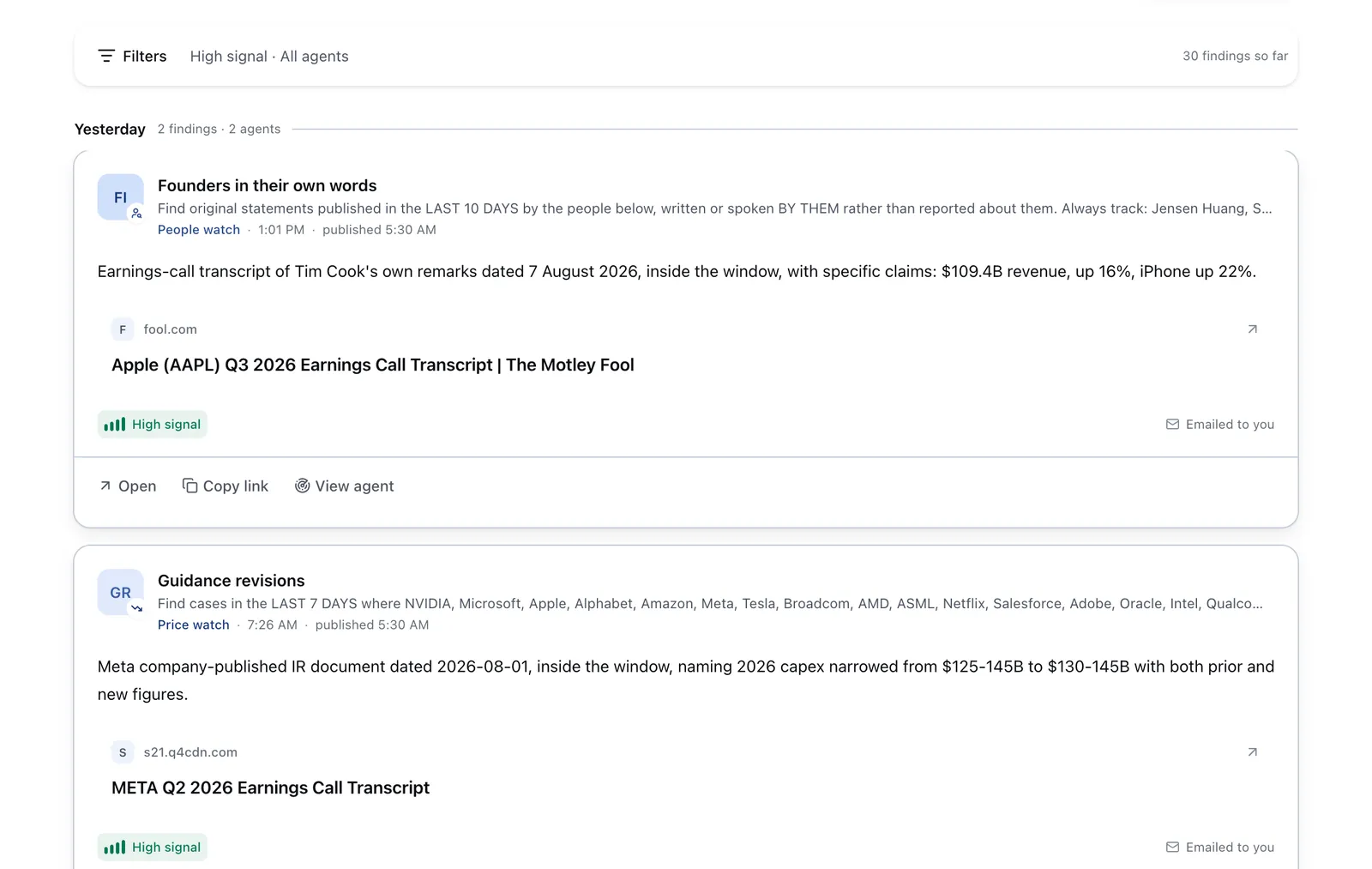
Use Parlel to keep a watch for roles that match both your skills and timezone constraints.
agent: remote_watch
keywords: react, typescript
eligibility: india_or_global
overlap: ist_or_cet_morning
digest: tuesday_10:00_ist
fields: company, role, location_rule, timezone, employer_check
Digest: roles with location and timezone fields to verify, plus the employer check before applying. Browse the job board, confirm the opening on the company site, and keep a record of the employment model.
Keep reading
Continue the workflow with three closely related guides: - how to use ai to find a job - startup job boards - work from home jobs india
Frequently asked questions
Which remote job board fits my search?
Pair a broad source with a curated or niche source and direct employer pages, based on role, country, and employment type.
Which boards have legitimate listings?
Prefer boards that disclose dates, employer, location eligibility, compensation where available, and moderation standards. Still verify the company; “remote” does not mean vetted.
Where can I find digital-nomad-friendly jobs?
Working Nomads, Remotive, Remote OK, and direct employer pages can be useful starting points. Require explicit country eligibility, work-from-anywhere language, contractor clarity, and timezone overlap.
How should applicants in India search?
Combine global remote filters with Cutshort, local sources, and company pages. Check payroll, tax, notice period, CTC, benefits, and actual office cadence.
How do I avoid remote-job scams?
Never pay to get a job, buy equipment, deposit a check, or send money back. Verify the opening and recruiter on the employer’s own domain and avoid unexpected text-only offers.