A referral request works best after a customer has experienced value and knows exactly who would benefit. The practical sequence is simple: choose a good moment, describe the target person, make the introduction easy, ask for permission, and record what happened. Do not promise a particular speed, retention outcome, or conversion result. Measure your own program.
TL;DR
- Customer Referrals is a founder-led growth and customer conversations guide: use it to make one decision, not to collect generic advice.
- Start with the smallest useful version: a signal, a specific next action, and a respectful exit; add complexity only when the evidence requires it.
- Treat every claim as either an observation, an estimate, or a hypothesis; do not present a signal as proof.
- Before you publish or act, check the buyer's words, a dated owner, and evidence that can be checked.
- The practical outcome is a dated next step, a clear owner, and a reason to stop or revisit the decision.
Timing and consent
Ask after a successful implementation, a positive unsolicited message, a renewal, an expansion, or a measurable milestone. Do not ask during an outage, support escalation, invoice dispute, or unresolved complaint. The customer’s mood matters, but so does consent: a customer should be able to decline without losing service or status.
Use one named profile: “Do you know an operations leader at a 20-100-person software company who is struggling with onboarding?” Avoid “anyone who might be interested.” If the customer agrees, ask whether you may mention their name and result. Do not disclose customer data to a prospect without permission.
Three scripts
Readout conversation
We reached [agreed result]. If you are comfortable, may I quote your words
about it and mention [company]? Also, do you know one [role] at a [company
type] dealing with [problem]? I can draft the note, and there is no pressure
to introduce us.
Follow-up after praise
Subject: may I quote you?

Thank you for saying “[exact words].” May I use that sentence in a case study?
If one peer comes to mind who is facing [specific problem], I can write a
forwardable note. It is completely fine if nobody comes to mind.
Renewal or quarterly check-in
Subject: [result] and one optional ask

How is [result] holding up? Before I ask anything else, is there a gap we
should fix? If the work is still useful, would you be comfortable forwarding
the short note below to one [target role]? Please edit or ignore it.
Forwardable introduction
Hi [Name] — [Customer] helped us with [problem]. We changed [metric or
workflow] from [before] to [after], using [short description]. If this is on
your list, I am happy to connect you with [Founder]. No need to respond if
the timing is wrong.
When a customer makes an introduction, thank them, tell them what happened, and honor any reward terms promptly. A reward is optional. Consider service credit, early access, a useful resource, or a reciprocal introduction, and check tax, advertising, procurement, and professional-conduct rules that may apply. Never condition a reward on a positive review or undisclosed endorsement.
Program design
| Field | Decision |
|---|---|
| Ideal referral | Role, company type, problem, geography |
| Trigger | Readout, praise, renewal, or milestone |
| Method | Email, forwarding blurb, or live introduction |
| Qualification event | Accepted intro, qualified meeting, pilot, or closed deal |
| Reward | Credit, service, early access, or none |
| Consent | What may be named, quoted, or shared |
| Follow-up | Thank-you, one nudge, then park |
Monthly or quarterly reminders are reasonable; do not ask every week. Referral Rock and HubSpot both emphasize timing, templates, qualification, tracking, and prompt follow-up. Treat those as process guidance, not a guaranteed lift.
Tracking template
customer | ask_date | trigger | target_profile | consent
prospect | introduction_status | qualified | opportunity_value
next_action | next_action_date | outcome | reward_status | source_url
Illustrative row: Acme | 2026-09-20 | readout | Head of Ops at 50-person SaaS | name may be shared | Riley | intro accepted | yes | 2026-09-27 | meeting scheduled | pending. Record the customer’s actual result separately from your interpretation. Track referral revenue and total reward/program cost so you can calculate payback rather than celebrate raw introductions.
If an introduction stalls, send one low-pressure nudge with the prepared note. Then park it until a new proof moment. If the referrer says no, record the decline and do not repeatedly re-ask without changed context.
Lost-deal and partner referrals
A lost deal can still identify the right owner, but only ask after acknowledging the decision. Partners can refer too, with a different consent and commercial arrangement. Make the relationship explicit to the referred person; hidden commissions damage trust and may create compliance issues.
Match the ask to the relationship
The wording should match what the customer has actually experienced. A customer who has only completed onboarding may be able to name a peer, but may not be comfortable endorsing a result. A customer who has renewed can usually speak to ongoing value, while a customer who praised a specific workflow can help you find a similar situation.
| Customer moment | Safe ask | Proof you may request |
|---|---|---|
| Successful setup | “Who else has this workflow?” | Permission to describe the use case |
| Measurable milestone | “Would one peer benefit from this?” | The agreed metric, if approved |
| Unsolicited praise | “May I quote that sentence?” | Exact quote and attribution |
| Renewal or expansion | “Would you forward this to one similar team?” | Renewal context, not private terms |
| Open support issue | No referral ask | Fix the issue first |
| Invoice dispute | No referral ask | Resolve the commercial issue |
Never make service quality, renewal treatment, or access to support depend on a referral. The request should be easy to decline and should not reveal that a customer uses your product to a third party without permission.
What to do after the introduction
Reply to the new prospect with the minimum context needed to make the introduction understandable. Thank the customer separately. If the introduction includes a claim about results, ask whether the customer approves that claim before repeating it. If the prospect does not respond, send one useful, low-pressure note and then park the thread. A referral is not permission for an indefinite sales sequence.
When a deal closes, report the outcome to the referrer without exposing confidential commercial details. “They chose to move forward” may be enough. If there is a reward, explain when it is earned, what form it takes, and whether procurement or tax rules affect it. Do not surprise a customer with a reward their employer cannot accept.
Illustrative referral path
Illustrative scenario, not a benchmark: After a customer readout, the customer says the onboarding workflow is easier to manage and names a peer at a similar company. The founder asks whether the customer may be named, sends a short forwardable note, and records that only the introduction is approved, not the customer’s metric or logo. The peer replies that the problem is not active. The founder thanks them, asks whether a future trigger would make it relevant, and parks the record. The customer is told the outcome and is not asked again until a new value moment.
The point is not to maximize introductions. It is to preserve trust while learning which customer situations travel to another account.
Incentive and compliance review
Before offering a reward, ask:
- Is the reward allowed under the customer’s procurement and professional-conduct rules?
- Is the offer clear about the qualifying event and payment timing?
- Does the recipient know the relationship or compensation involved?
- Could the reward be interpreted as buying a review or undisclosed endorsement?
- Do local tax, advertising, consumer-protection, or industry rules apply?
- Can the program work without an incentive for customers who cannot accept one?
For regulated customers, a useful resource or service credit may still be restricted. Ask the customer to check their policy rather than asking them to make an exception. Keep public testimonials and private introductions as separate consent decisions.
Referral operations checklist
- Confirm a recent value moment and unresolved support issues.
- Define the target role, company shape, problem, and geography.
- Ask permission to name the customer, quote them, or share results.
- Offer a forwardable note the customer can edit or ignore.
- Record consent and the source before contacting the prospect.
- Thank the referrer immediately after the introduction.
- Use one nudge at most unless the prospect opts into more contact.
- Record qualification, opportunity, outcome, and reward status separately.
- Report the result without disclosing confidential terms.
- Re-ask only after changed context or a new value moment.
Measure quality, not just volume
A referral program can look busy while producing poor-fit prospects. Track the customer’s target profile, whether the introduction was accepted, whether the prospect was qualified, whether a meeting happened, and what the prospect ultimately decided. Keep the source of the referral visible through the process so revenue and program costs can be compared later.
| Stage | Record | Do not infer |
|---|---|---|
| Ask | Trigger, wording, consent | Customer satisfaction from willingness to help |
| Introduction | Referrer, date, channel, permission | Buying intent from a warm email |
| Qualification | Problem, owner, urgency, budget path | Fit from the referrer’s reputation |
| Opportunity | Scope, value, next action | Closed revenue from a meeting |
| Outcome | Won, lost, nurture, opt-out | Program quality from raw introductions |
If referrals produce many curious conversations but few qualified opportunities, tighten the target profile or improve the forwardable note. If referrals are well qualified but stall, examine the offer, proof, or buying process. Do not pressure customers to send more introductions to compensate for a weak handoff.
When a customer says no
Say thank you and ask whether the product or service still has an unresolved issue. A customer may decline because of policy, workload, privacy, or a poor timing window, not because they are unhappy. Record the reason only if they volunteer it. Suppress repeated requests until a new value moment, and never make the customer explain a refusal.
The same rule applies to testimonials. A customer can approve a private reference while declining public use of their name. Track these permissions independently so a sales system does not accidentally turn a private introduction into a public claim.
Referral review checklist
- Check customer health, open support issues, and commercial disputes.
- Define one target profile and one problem.
- Ask permission before naming, quoting, or sharing results.
- Give the customer a note they can edit, forward, or ignore.
- Track the introduction and qualification separately.
- Thank the referrer and report the outcome without confidential detail.
- Apply one low-pressure follow-up and then park the prospect.
- Review reward, tax, procurement, advertising, and disclosure rules.
- Compare qualified outcomes and program cost, not introductions alone.
- Re-ask only when the context has materially changed.
The customer referrals operating standard
This guide is written for a reader who needs to use customer referrals in a real workflow, not merely understand the definition. The dependable version starts with the decision that must be made, names the evidence available today, and keeps the next step small enough to complete. That is the editorial standard used throughout this guide and across the Parlel library: practical guidance should help a founder, operator, candidate, or freelancer act without hiding uncertainty behind confident language.
Decide what success means before you start
Write the result in one sentence: “After this exercise, I will know whether , and the next action will be .” For customer referrals, that sentence prevents the most common failure mode — doing more research after the useful question has already been answered. If the work concerns a person, company, role, client, or vendor, record the source and date as you go. If it concerns a template or message, define the recipient, context, and desired response before polishing the wording.
Use a small fixture rather than an abstract example. Pick three to five real records, situations, or drafts and run the method end to end. Keep one case that should succeed, one ambiguous case, and one case that should be rejected. That mix exposes whether the process can distinguish a useful signal from a convenient story. It also gives you material for a later review without pretending that a tiny sample is a benchmark.
Make the work explainable to another person
A high-quality result should survive a handoff. Another person should be able to see what was known at the time, which assumptions were made, what action was taken, and what would change the decision. For this topic, preserve the original input alongside the conclusion. Keep a short “why now” note, the owner, the due date, and the stop condition. This makes customer referrals useful in an agency-style operating system: the work is repeatable without becoming mechanical, and a reviewer can improve it without rewriting the whole process.
Quality-control pass before you ship
- Intent: Does the page answer the query implied by its title in the first screen?
- Evidence: Are current facts linked to a source, date, or clearly labeled assumption?
- Specificity: Could a reader use the checklist, script, table, or example immediately?
- Boundaries: Does the guide say when the method is a poor fit or should stop?
- Next action: Is there one useful action rather than a pile of competing calls to action?
Those checks matter more than adding another paragraph of general advice. They also protect search quality: the page earns attention by resolving the reader's problem, not by repeating customer referrals unnaturally. If the evidence is thin, say so and explain how to improve it. If the answer changes by country, role, plan, or company size, make that branch visible instead of burying it in a footnote.
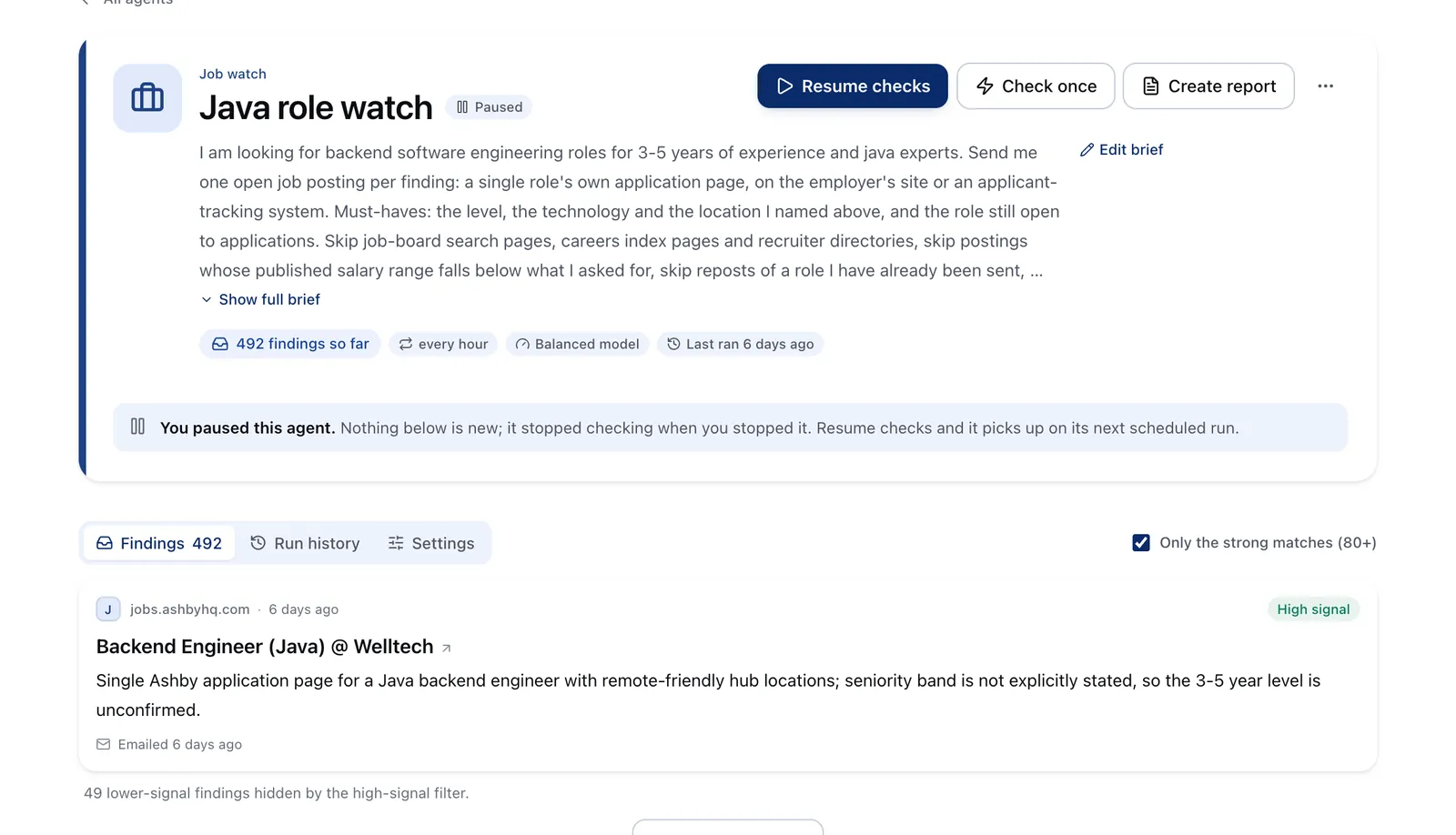
Run it on Parlel
Use a monthly digest to prepare a permission-aware referral queue.
REFERRAL DIGEST
- customer: { name, approved_proof, last_value_moment }
- lookalikes: [{ company, reason, source_url, confidence }]
- movers: [{ person, new_company, relationship_status }]
- action: { ask|draft_forward|thank|nudge_once|park }
- guardrail: consent_checked = true
Use the company directory for lookalike research and the people directory to verify roles. Do not expose private customer information or auto-send a referral request.
Keep reading
Continue the workflow with three closely related guides: - sales follow up email template - how to get first 10 customers - how to find freelance clients