A useful sales follow-up email does more than announce that you are still waiting. It reminds the reader why the conversation matters, adds something worth opening, and makes the next action easy. The templates below are deliberately short. Replace the brackets with facts you actually know, remove anything that is not true, and stop when a person asks you to stop.
These are starting points, not a promise of a particular reply rate. The research brief for this guide found that current sales guidance clusters around several situations: after no response, after a meeting, after a proposal, a value-add note, an internal-forwarding note, reactivation, and a polite close. It also suggests an initial follow-up around three to five days after an unanswered cold email, with later attempts spaced farther apart. Test the timing against your buyers.
TL;DR
- Sales Follow Up Email Template is a founder-led growth and customer conversations guide: use it to make one decision, not to collect generic advice.
- Start with the smallest useful version: a signal, a specific next action, and a respectful exit; add complexity only when the evidence requires it.
- Treat every claim as either an observation, an estimate, or a hypothesis; do not present a signal as proof.
- Before you publish or act, check the buyer's words, a dated owner, and evidence that can be checked.
- The practical outcome is a dated next step, a clear owner, and a reason to stop or revisit the decision.
Quick-use matrix
| Situation | Starting wait | Objective | One clear CTA | Stop condition |
|---|---|---|---|---|
| No response to cold email | 3-5 business days | Add a new angle | “Is this relevant?” | No fit or opt-out |
| After a discovery call | Same day or next morning | Confirm the record | “Is this recap right?” | Recap accepted or deal closed |
| After a demo | 1-2 business days | Tie product to a stated problem | Choose a next step | No active problem |
| After sending a proposal | 3-5 business days | Remove a decision obstacle | “What should we change?” | Decision made |
| Value-add follow-up | When you have something useful | Earn attention without pitching | Permission to send more | No interest |
| Internal forwarding | After buyer agrees to share | Equip the champion | “Can I draft the intro?” | Stakeholder declines |
| Reactivation | 30-90 days or a real trigger | Check whether context changed | “Worth reopening?” | Still not a priority |
| Close the loop | After the agreed sequence | Give an easy exit | “Close or revisit?” | Close, opt-out, or no answer |
| Referral pass | After a respectful close | Find the right owner | “Who handles this?” | No referral or opt-out |
The wait column is a practical starting point, not an industry optimum. A post-call recap should not wait five days; a proposal follow-up should respect the review date the buyer gave you. If the buyer says “next Tuesday,” use that commitment rather than an imported cadence.
The rules that keep follow-ups human
- Open with context. Mention the call date, proposal, problem, or trigger in the first two lines. A reader should not have to search the thread.
- Add one new thing. It can be a relevant answer, a small observation, a clearer scope, or a useful document. Do not invent a case study or a metric.
- Ask one question. “Any thoughts?” is weaker than “Is reducing onboarding time a priority this quarter?”
- Make claims traceable. If you use a customer result, get permission and name the source or describe it as an illustrative example.
- Respect consent and channel rules. Honor opt-outs, keep commercial email compliant with the laws that apply to your sender and recipient, and do not use a personal address after someone asks you not to.
Nine sales follow-up email templates
1. After no response
Subject: [specific problem] at [company]

Hi [Name] — following up on my note about [problem].

I noticed [new, public fact or useful observation]. If that means
[likely consequence], I can send a one-page way to assess it. Is this
on your list this quarter, or should I close the loop?

[Name]
Use the observation only if it is current and relevant. Do not turn a job posting into a claim that the company definitely has a problem; say “may indicate” when the signal is ambiguous.
2. After a discovery call
Subject: recap: [problem] and [next step]

Hi [Name] — thanks for the conversation today. I heard:

- Current process: [factual summary]
- Cost or risk: [their estimate, labeled as an estimate]
- Desired outcome: [their words]
- Open question: [question still to answer]

If that is accurate, I will send [specific artifact] by [date]. Are you
still comfortable reviewing it with [stakeholder] on [date/time]?
This format is especially useful after a discovery call. Send the buyer a chance to correct your notes. A correction is useful information, not a setback.
3. After a demo
Subject: the [workflow] we discussed

Hi [Name] — the part of the demo most connected to your situation was
[feature or workflow], because you said [specific problem].

I attached [short, relevant item]. It does not cover [known limitation].
Would a 20-minute session with [stakeholder] to test [success criterion]
be useful, or is there another question to answer first?
Naming a limitation is often more credible than adding another feature paragraph.
4. After sending a proposal
Subject: proposal question

Hi [Name] — checking whether the proposal answered the three things we
discussed: [outcome], [implementation concern], and [commercial constraint].

If one section is blocking review, tell me which one. I can revise scope,
timeline, or assumptions; I do not want to defend a document that does not
fit your approval process.
Do not send a discount simply because the buyer has not replied. First find out whether the obstacle is scope, authority, risk, timing, or no problem.
5. Value-add follow-up
Subject: a small check for [workflow]

Hi [Name] — I saw [relevant article, launch, role, or change] and made a
short checklist for [specific task]. It is useful even if we never work
together: [link or attachment].

If you use it, I would be interested in what it misses. No meeting needed.
The “no meeting needed” line is appropriate only when you mean it. A free teardown that is secretly a forced sales call is not value-add follow-up.
6. Internal-forwarding note
Subject: note for [stakeholder]

Hi [Name] — you mentioned [stakeholder/team] will weigh in. Here is a
forwardable summary:

“We are evaluating [category] to address [problem]. The question is whether
[success criterion] is worth [scope/cost]. Could you advise on [one question]?”

Would you like me to adjust that to match your internal language?
Give the champion a sentence they can forward without pretending that they have already approved the purchase.
7. Reactivation after a real trigger
Subject: reopen [problem]?

Hi [Name] — we paused this in [month] because [reason]. I noticed [new
fact], which may change the timing. Has [problem] moved back onto the
roadmap, or is it still sensible to leave it closed?

Either answer is useful; I will update my notes.
Reactivation works best when the trigger is specific. “Just checking in” is not a trigger.
8. Close the loop
Subject: close the loop?

Hi [Name] — I have followed up on [topic] and do not want to add noise.

Should I close this for now, keep it open until [date], or send one answer
about [open question]? A one-word reply is fine.
If the buyer says close, close it. Do not send a “last last” email a week later.
9. Referral pass
Subject: one quick question

Hi [Name] — understood that [problem] is not a priority right now. Who owns
it when it becomes relevant? I can send them the same short context and let
them decide whether to respond. No introduction is necessary unless you are
comfortable making one.
Referral requests should be specific and optional. The customer referrals guide includes a tracking model for this handoff.
A simple 21-day operating sequence
For a warm thread, try a recap on day 0, a useful answer or asset on day 3-5, a process or stakeholder question around day 8-10, and a close-the-loop note around day 14-21. A cold thread may need fewer touches and more distance. If the person replies, books, opts out, or asks for a later date, stop the sequence and update the record.
Track sent, delivered, positive_reply, meeting_booked, proposal_sent, opt_out, bounce, sequence_stopped, and closed. Define each field before comparing cohorts. A positive reply is not the same as any reply, and a meeting is not the same as a qualified opportunity. Review by situation, segment, and date; do not call a winner from a handful of sends.
Automation without surrendering judgment
Automate reminders, task creation, and sequence stops when a reply or meeting occurs. Keep the recipient, claim, first line, and selected template under human review. A safe checklist is:
- Verify the address and the factual trigger.
- Check suppression and opt-out records.
- Confirm the message has one CTA and no unsupported result.
- Stop all automated touches after a reply, bounce, or explicit no.
- Review unsubscribe and complaint signals before increasing volume.
The research supports automation of scheduling and stopping, not a claim that a particular tool improves conversion. Use your outbound sales strategy to decide which channel deserves a test.
Diagnose the silence before writing
Silence can mean the message was irrelevant, the recipient is not the owner, the timing changed, the thread was lost, or the buyer does not want contact. These causes require different actions. A new subject line cannot fix a wrong recipient, and a discount cannot create a problem that does not exist.
| Observation | Plausible interpretation | Safer next move |
|---|---|---|
| No delivery or bounce | Bad address or domain issue | Correct or suppress the record |
| Delivered, no reply | Unknown: fit, timing, priority, or disinterest | One useful angle, then stop |
| “Not me” | Ownership mismatch | Ask one routing question |
| “Later” with a date | Timing constraint | Record the date and pause |
| Proposal viewed, no response | Review or approval obstacle | Ask which section is blocked |
| Explicit no or opt-out | Permission withdrawn | Suppress immediately |
Do not convert an open or click into evidence of buying intent. Those signals can be useful for prioritizing a review, but the recipient’s words and actions are stronger evidence. If a tracking system exposes personal or sensitive information, limit access and follow the privacy rules that apply to your market.
Three realistic operating situations
Illustrative cold-thread scenario, not a benchmark: A founder sends a note based on a new support role. The buyer does not reply. Three business days later, the founder sends a short checklist about handoffs, states that the hiring signal may or may not indicate a workflow issue, and asks whether the topic belongs to the recipient. After another interval, the founder closes the loop. The founder records “no response,” not “interested but busy.”
Illustrative proposal scenario, not a benchmark: A buyer promised to review a proposal with finance on Tuesday. The seller follows up Wednesday, references the three assumptions in the proposal, and asks which assumption finance wants changed. The seller does not attach a new discount because the obstacle is unknown. If the buyer says budget is deferred, the opportunity is dated for the actual planning cycle rather than kept active indefinitely.
Illustrative referral scenario, not a benchmark: A prospect says the problem is not a priority but names the operations team. The seller asks whether a short forwardable note would be welcome and whether the prospect may be named. If not, the seller sends no unsolicited message to the other team.
Editing checklist before send
- Check the thread, date, recipient role, and last stated commitment.
- Remove claims you cannot source or the buyer did not authorize.
- Add one new fact, answer, or useful artifact.
- Ask one question that can be answered without a meeting.
- State a clear stop or pause condition.
- Verify suppression, consent, and applicable commercial-email rules.
- Check links, attachments, and the sender identity.
- Schedule a task only if a person will review it.
The best close-the-loop email is one you actually honor. Keeping a clean record is more valuable than extracting a final reply from someone who has chosen not to engage.
Keep the record useful
After each touch, record the reason for the message, the source of any new claim, the recipient’s response, and the next permitted action. “Followed up” is not enough for a teammate who inherits the thread. Write whether the buyer corrected the problem, named another owner, requested a date, opted out, or gave no signal.
Use a short outcome vocabulary so reports remain comparable:
| Outcome | Meaning |
|---|---|
positive_reply |
Relevant interest or useful buying context |
routing_reply |
Another owner named or target corrected |
nurture |
The problem may matter later and a date or trigger exists |
disqualified |
Account, problem, authority, or channel is not a fit |
opt_out |
The recipient asked not to receive further contact |
no_response |
No reply after the defined sequence |
Do not quietly move no_response to nurture to make a dashboard look healthier. Nurture requires a reason and a future condition. A clean close is a useful sales outcome because it protects the relationship and keeps the active list honest.
Final follow-up review
Before a sequence starts, decide how many attempts are appropriate for the relationship, what counts as a reply, and who owns suppression. Before each send, open the source, read the last thread, and ask whether the new message would be useful if there were no sale. If the answer is no, stop or wait for a real trigger.
The sales follow up email template operating standard
This guide is written for a reader who needs to use sales follow up email template in a real workflow, not merely understand the definition. The dependable version starts with the decision that must be made, names the evidence available today, and keeps the next step small enough to complete. That is the editorial standard used throughout this guide and across the Parlel library: practical guidance should help a founder, operator, candidate, or freelancer act without hiding uncertainty behind confident language.
Decide what success means before you start
Write the result in one sentence: “After this exercise, I will know whether , and the next action will be .” For sales follow up email template, that sentence prevents the most common failure mode — doing more research after the useful question has already been answered. If the work concerns a person, company, role, client, or vendor, record the source and date as you go. If it concerns a template or message, define the recipient, context, and desired response before polishing the wording.
Use a small fixture rather than an abstract example. Pick three to five real records, situations, or drafts and run the method end to end. Keep one case that should succeed, one ambiguous case, and one case that should be rejected. That mix exposes whether the process can distinguish a useful signal from a convenient story. It also gives you material for a later review without pretending that a tiny sample is a benchmark.
Make the work explainable to another person
A high-quality result should survive a handoff. Another person should be able to see what was known at the time, which assumptions were made, what action was taken, and what would change the decision. For this topic, preserve the original input alongside the conclusion. Keep a short “why now” note, the owner, the due date, and the stop condition. This makes sales follow up email template useful in an agency-style operating system: the work is repeatable without becoming mechanical, and a reviewer can improve it without rewriting the whole process.
Quality-control pass before you ship
- Intent: Does the page answer the query implied by its title in the first screen?
- Evidence: Are current facts linked to a source, date, or clearly labeled assumption?
- Specificity: Could a reader use the checklist, script, table, or example immediately?
- Boundaries: Does the guide say when the method is a poor fit or should stop?
- Next action: Is there one useful action rather than a pile of competing calls to action?
Those checks matter more than adding another paragraph of general advice. They also protect search quality: the page earns attention by resolving the reader's problem, not by repeating sales follow up email template unnaturally. If the evidence is thin, say so and explain how to improve it. If the answer changes by country, role, plan, or company size, make that branch visible instead of burying it in a footnote.
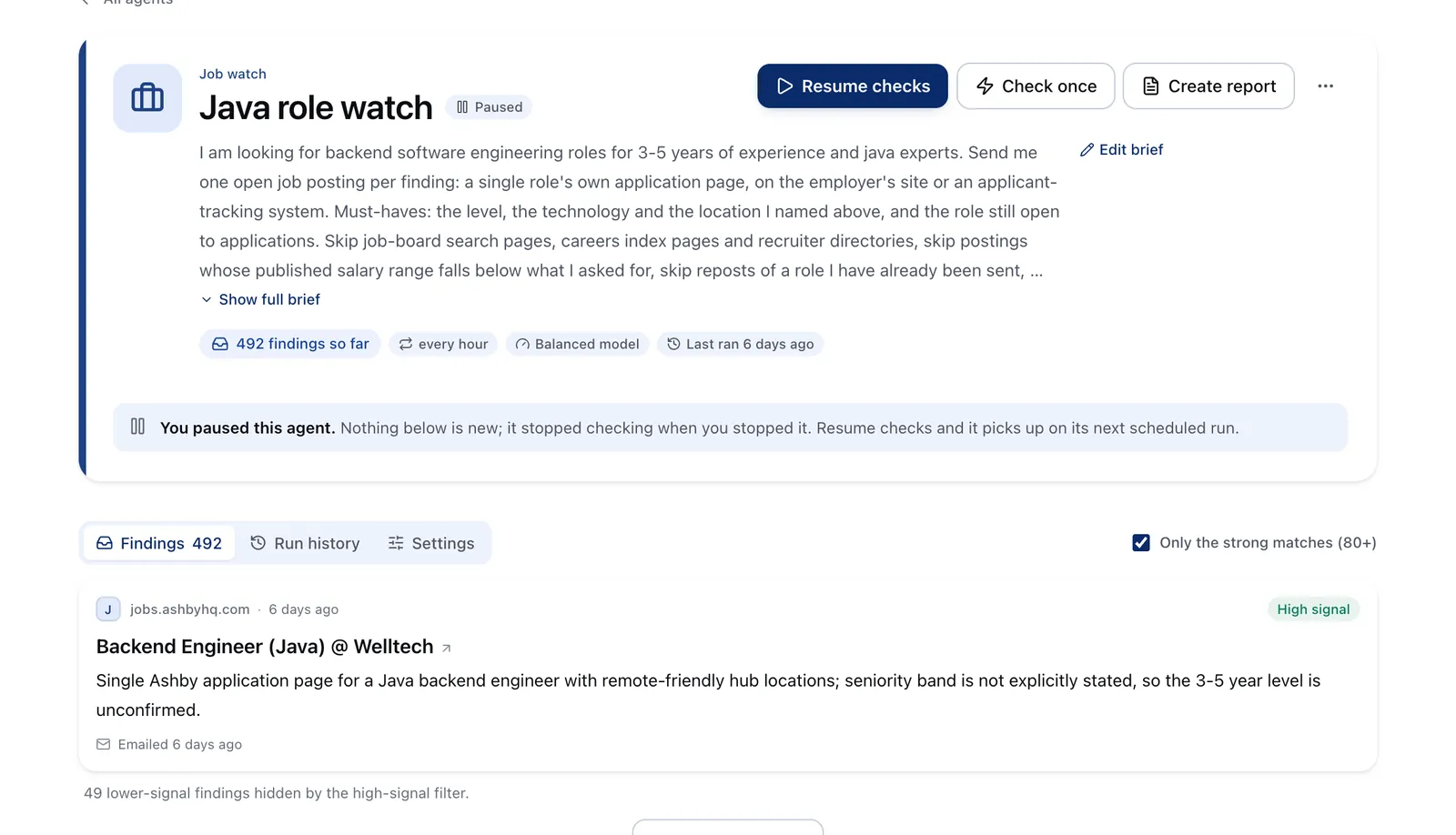
Run it on Parlel
Use a weekly account digest to suggest context, not to auto-send copy.
FOLLOW-UP DIGEST (weekly)
- account: { name, last_touch, open_thread, known_trigger }
- evidence: { source_url, observed_at, confidence: high|medium|low }
- next_action: { recap|value_add|reactivate|close|referral }
- review: human_required = true
Open the source, reject weak or stale signals, then choose the template that matches the thread. Keep the final decision and the wording with a person.
Keep reading
Continue the workflow with three closely related guides: - discovery call questions - outbound sales strategy - how to ask customers for referrals