Finding freelance clients is not mainly a website problem. It is a repeatable process for choosing a buyer, showing relevant proof, finding a visible need, making a specific offer, and following up without wasting time on bad-fit work. Start with people who already know your work, then add selective marketplaces, communities, and targeted outreach.
There is no reliable universal number of pitches, days to a first client, or channel conversion rate to copy. Treat this guide as an operating system: choose a narrow offer, create evidence, work a small list, learn from replies, and protect time for delivery.
TL;DR
- How To Find Freelance Clients is a independent work and client operations guide: use it to make one decision, not to collect generic advice.
- Start with the smallest useful version: a defined scope, a payment boundary, and a repeatable operating habit; add complexity only when the evidence requires it.
- Treat every claim as either an observation, an estimate, or a hypothesis; do not present a signal as proof.
- Before you publish or act, check the signed terms, the delivery evidence, and the cash-flow risk.
- The practical outcome is a dated next step, a clear owner, and a reason to stop or revisit the decision.
The seven-step system
1. Position around a buyer and outcome
Use this sentence: “I help [specific buyer] achieve [business outcome] through [mechanism].” For example: “I help B2B SaaS teams improve demo-to-trial conversion through landing-page and onboarding audits.” A narrow promise makes a prospect list possible. “I do design, writing, and development” makes the buyer do the sorting.
2. Package proof
Prepare three assets: a short case study with the starting problem and result, a process example or teardown, and a public profile with service, availability, and contact path. If you lack client history, create a clearly labeled sample or do a small pilot. Never invent outcomes.
3. Start with warm routes
Message former clients, employers, colleagues, collaborators, and friends with a specific description of the work you want. Ask whether they know a team facing that problem, not whether they know “anyone who needs a freelancer.” Join one or two relevant communities and contribute before pitching.
4. Build a qualified list
Record company, buyer, visible trigger, problem hypothesis, likely scope, and next step. Hiring for the function you support can signal a temporary gap, but it does not prove budget or authority. Qualify budget, decision-maker, urgency, scope, and fit before writing a long proposal.
Use a simple qualification row:
| Field | Question |
|---|---|
| Problem | What public evidence suggests a need? |
| Buyer | Who owns the result or budget? |
| Urgency | What event makes the work timely? |
| Scope | What bounded first deliverable could be bought? |
| Fit | Can you show relevant proof and deliver well? |
| Next step | What small action would confirm interest? |
If three of these fields are guesses, keep researching instead of writing a long pitch.
5. Write a diagnostic opener
Subject: one observation about [company]

Hi [name] - I noticed [specific public evidence]. That may make [business consequence]
harder while [relevant initiative] is underway. I recently helped [similar buyer]
with [relevant outcome or artifact]. Would a short review of [bounded deliverable]
be useful, or is this not a priority this quarter?
Keep it specific. Do not lead with a biography or a list of every service you can perform.
6. Follow up with value
Try a suggested sequence, not a proven universal standard: day 0 diagnosis, day 4 relevant proof, day 11 a new observation, and day 21 a graceful close. Stop when the person says no or asks not to be contacted. A follow-up should add information, not repeat “just bumping this.”
Example sequence:
| Touch | Purpose | Example |
|---|---|---|
| 0 | Relevant observation | “I noticed your new hiring page lists two lifecycle roles.” |
| 4 | Proof | Share one related, truthful artifact or case study. |
| 11 | New angle | Explain one bounded improvement you would inspect. |
| 21 | Close | Ask whether to pause and leave a useful resource. |
The cadence is a suggested rule, not an industry benchmark. Honor a request not to be contacted and follow applicable platform and anti-spam rules.
7. Ask for referrals after delivery
At the close of a successful project, request a testimonial, permission to describe the work, and one or two introductions. Make forwarding easy: “I help [buyer] with [outcome]. If someone in your network is facing that issue, would you forward this note?” Then invoice using a consistent freelance invoice template and keep the relationship warm.
Which channels fit?
| Channel | Use first when | Watch for |
|---|---|---|
| Former clients and colleagues | You have any credible past work | Asking vaguely |
| Referrals | A client saw a clear result | Waiting until months later |
| LinkedIn or communities | Your buyer discusses the problem publicly | Pitching before contributing |
| Upwork | You can diagnose posted custom work | Proposal volume and fee variability |
| Fiverr | You can package a bounded outcome | Revision and price pressure |
| Agencies | You can provide overflow reliably | Margin and scope ambiguity |
| Open professional directory | Buyers search profiles and proof | Incomplete positioning |
Use one or two active discovery channels and one owned profile. Platforms and rules change; verify current fees and off-platform communication restrictions before relying on them. The Upwork vs Fiverr comparison covers their different models.
Weekly pipeline
Reserve a small recurring block: review existing relationships, add a handful of qualified prospects, send researched messages, follow up, publish one proof asset, and ask one client for a referral. Track sends, positive replies, calls, proposals, wins, revenue, and source. Do not optimize for sends alone. If a channel creates replies but no qualified calls, change the offer or qualification.
At the end of each week, classify every open lead as active, waiting on buyer, nurture, disqualified, or closed. Write the reason for disqualification. This prevents a large “follow up later” list from hiding that the offer, buyer, or timing is wrong.
Who should not use this playbook unchanged
Do not use cold outreach as the first answer if your former clients are uncontacted, your offer is unclear, or you have no proof. Do not pitch companies that cannot explain who buys your service. Do not send a high-volume sequence that ignores consent, platform rules, or personal relevance. If you are fully booked, focus on referrals, repeat work, and a waitlist rather than creating demand you cannot serve.
Do not use this playbook unchanged for a regulated profession, confidential client work, or work that requires a license or formal procurement process. Adapt the proof, outreach, data handling, and contract steps before contacting prospects.
Choose a channel by the constraint
| Your constraint | Start with | Why | First action |
|---|---|---|---|
| You have past work but little new demand | Former clients and colleagues | Trust already exists | Send a specific availability note |
| You have proof but no network in the niche | Communities and targeted LinkedIn research | Learn the buyer's language | Contribute before pitching |
| You need custom work soon | Selective marketplace proposals | Existing demand is visible | Apply only when the fit is clear |
| Your service is repeatable | A productized offer or Fiverr gig | Buyers can understand the package | Define inputs, output, and revisions |
| You want larger ongoing work | Agencies and direct outreach | Partners may need reliable capacity | Offer bounded overflow support |
| You are fully booked | Referrals and a waitlist | Demand should not outrun capacity | Ask for introductions without promising dates |
Use one or two discovery channels and one owned profile. More channels do not create a stronger system if you cannot research, reply, qualify, and deliver. A channel is working when it produces a useful next conversation, not when it produces a high number of impressions or sends.
A qualification call that protects your calendar
Before writing a proposal, ask what changed, who owns the decision, what outcome matters, what must be delivered first, when it is needed, what inputs exist, and how approval works. You do not need a rigid script, but you do need a way to discover budget, authority, urgency, scope, and fit.
| Qualification area | Useful question | Red flag |
|---|---|---|
| Problem | What prompted this now? | No concrete consequence |
| Authority | Who approves the work? | Decision-maker is invisible |
| Urgency | What date or event matters? | “As soon as possible” only |
| Scope | What is the smallest useful first output? | Unlimited exploration |
| Budget | How is this type of work funded? | Price is deferred indefinitely |
| Fit | What proof would make you confident? | Your relevant experience is not valued |
Illustrative example: a company hiring for a marketing role may have a temporary capability gap, but the job post does not prove it will buy freelance help. Use the signal to form a hypothesis, then ask a relevant person whether a bounded audit or interim deliverable would help. If the answer is no, close or nurture the lead rather than forcing the signal into a pitch.
Follow-up without a volume fantasy
A suggested four-touch sequence can be day 0 diagnosis, day 4 relevant proof, day 11 a new observation, and day 21 a respectful close. It is an operating rule, not a proven conversion rate or a requirement to contact everyone four times. Stop when someone says no, asks not to be contacted, or clearly has no fit. Follow applicable anti-spam and platform rules.
Every follow-up should earn its place. Add a useful artifact, correct an assumption, narrow the proposed first step, or give the person an easy way to defer. Do not disguise a repeated sales request as a new insight. Keep the sequence short enough that you can maintain accurate records and remove people who opt out.
Weekly client pipeline review
Use a simple table with company, buyer, trigger, problem hypothesis, offer, stage, next action, date, owner, and reason lost or paused. On Monday, repair overdue actions. Midweek, add a small number of researched prospects. On Friday, review replies, calls, proposals, wins, revenue, and capacity. Separate “waiting on buyer” from “not qualified” so a quiet list does not look like an active pipeline.
At the end of the month, ask which problems produced good work, which sources produced poor-fit conversations, and which offer language was understood. Change one variable at a time when possible. Do not copy a competitor's claimed conversion rate or promise a timeline you have not observed.
From first project to durable relationship
At delivery, ask what outcome was useful, what remains unresolved, and whether a follow-on review makes sense. Request a testimonial or permission to describe the work only when the client is satisfied and confidentiality permits it. Send a clear invoice, keep the scope record, and schedule a future check-in only with permission. A retainer should follow recurring value, not be used to hide an unfinished project.
The how to find freelance clients operating standard
This guide is written for a reader who needs to use how to find freelance clients in a real workflow, not merely understand the definition. The dependable version starts with the decision that must be made, names the evidence available today, and keeps the next step small enough to complete. That is the editorial standard used throughout this guide and across the Parlel library: practical guidance should help a founder, operator, candidate, or freelancer act without hiding uncertainty behind confident language.
Decide what success means before you start
Write the result in one sentence: “After this exercise, I will know whether , and the next action will be .” For how to find freelance clients, that sentence prevents the most common failure mode — doing more research after the useful question has already been answered. If the work concerns a person, company, role, client, or vendor, record the source and date as you go. If it concerns a template or message, define the recipient, context, and desired response before polishing the wording.
Use a small fixture rather than an abstract example. Pick three to five real records, situations, or drafts and run the method end to end. Keep one case that should succeed, one ambiguous case, and one case that should be rejected. That mix exposes whether the process can distinguish a useful signal from a convenient story. It also gives you material for a later review without pretending that a tiny sample is a benchmark.
Make the work explainable to another person
A high-quality result should survive a handoff. Another person should be able to see what was known at the time, which assumptions were made, what action was taken, and what would change the decision. For this topic, preserve the original input alongside the conclusion. Keep a short “why now” note, the owner, the due date, and the stop condition. This makes how to find freelance clients useful in an agency-style operating system: the work is repeatable without becoming mechanical, and a reviewer can improve it without rewriting the whole process.
Quality-control pass before you ship
- Intent: Does the page answer the query implied by its title in the first screen?
- Evidence: Are current facts linked to a source, date, or clearly labeled assumption?
- Specificity: Could a reader use the checklist, script, table, or example immediately?
- Boundaries: Does the guide say when the method is a poor fit or should stop?
- Next action: Is there one useful action rather than a pile of competing calls to action?
Those checks matter more than adding another paragraph of general advice. They also protect search quality: the page earns attention by resolving the reader's problem, not by repeating how to find freelance clients unnaturally. If the evidence is thin, say so and explain how to improve it. If the answer changes by country, role, plan, or company size, make that branch visible instead of burying it in a footnote.
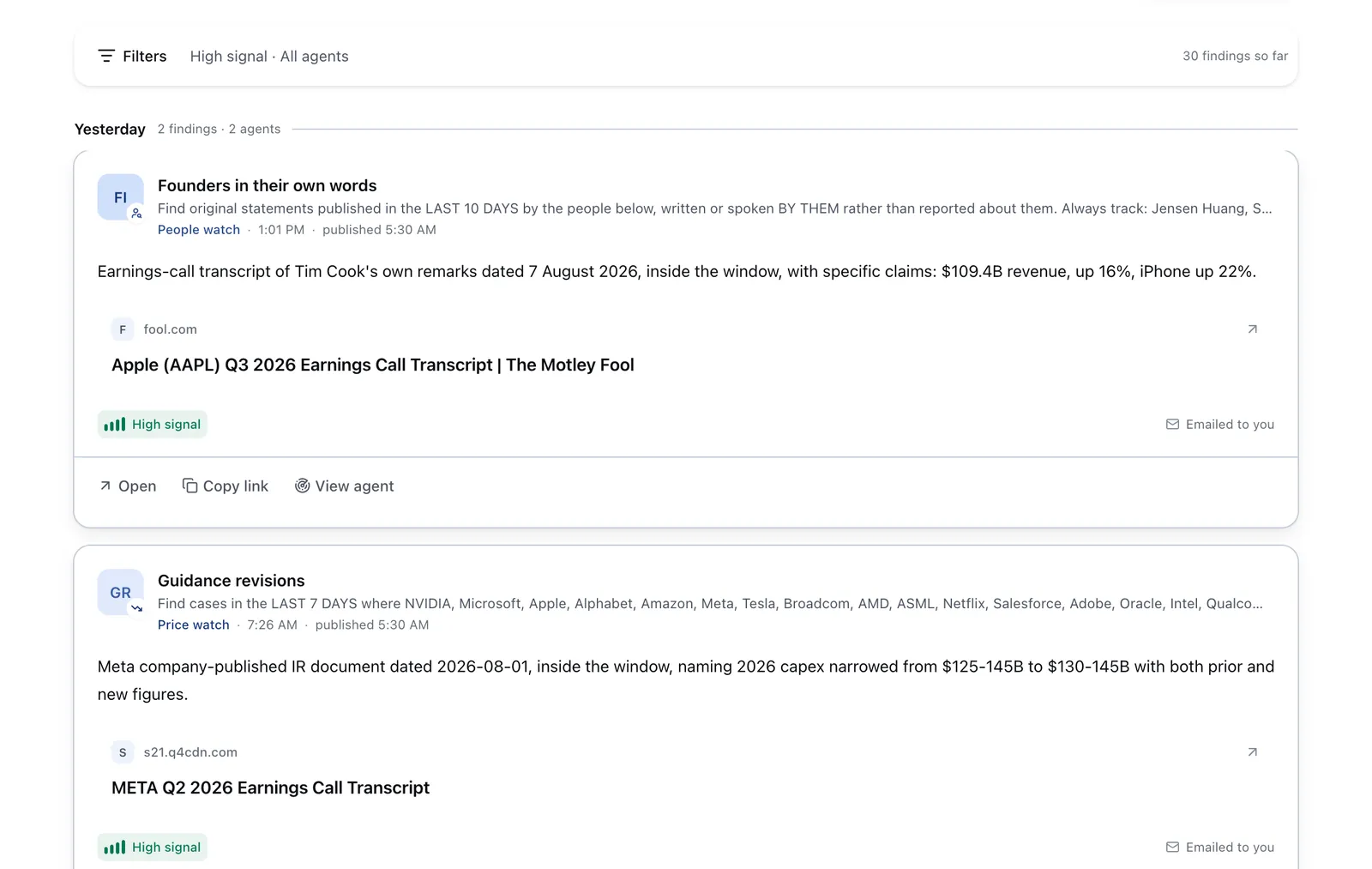
Run it on Parlel
Use company hiring pages as one public trigger for a client list, then do human research before contacting anyone.
{"agent":"freelance-client-list","schedule":"weekly","filters":{"hiring":true,"size":"11-200","roles":"your_service"},"digest":{"fields":["company","open_roles","buyer_hint","gap_hypothesis","opener"],"deliver":"client_prospect_digest"}}
Digest: company, relevant roles, buyer hint, gap hypothesis, and a draft opener. Review the source pages in Parlel Explore.
Keep reading
Continue the workflow with three closely related guides: - freelance invoice template - how to ask customers for referrals - sales follow up email template
FAQs
How do I get my first freelance client?
Choose one small outcome, create a sample or pilot, ask your existing network for relevant introductions, and contact a small list with a specific diagnosis.
Which freelance website is best?
It depends on deal shape. Upwork fits custom work and proposals; Fiverr fits fixed packages; directories and communities support longer-term positioning.
How many pitches should I send?
Use a volume you can research and follow up on. Track positive replies and qualified calls rather than treating send count as progress.
How do I follow up without being annoying?
Add a useful observation, space messages out, stop after a respectful sequence, and honor a request not to contact someone.