A retainer agreement records an ongoing exchange: the client pays for reserved hours, deliverables, or access, and the provider defines what is included and what is not. It is not a promise of unlimited availability. This template is a starting framework, not legal advice. Adapt tax, employment, IP, consumer, and governing-law terms with local counsel for material engagements.
Choose the commercial model before copying clauses. An hours retainer sells capacity, a deliverables retainer sells named outputs, and an access retainer sells availability or priority. Those promises are not interchangeable: “ten hours available” does not guarantee ten finished deliverables, and “monthly reporting” does not guarantee unlimited revisions.
TL;DR
- Retainer Agreement Template is a independent work and client operations guide: use it to make one decision, not to collect generic advice.
- Start with the smallest useful version: a defined scope, a payment boundary, and a repeatable operating habit; add complexity only when the evidence requires it.
- Treat every claim as either an observation, an estimate, or a hypothesis; do not present a signal as proof.
- Before you publish or act, check the signed terms, the delivery evidence, and the cash-flow risk.
- The practical outcome is a dated next step, a clear owner, and a reason to stop or revisit the decision.
Choose the retainer model first
| Model | Client buys | Important rule |
|---|---|---|
| Hours-based | A defined number of hours or days | Track use, overage, and rollover |
| Deliverables-based | A named monthly output | Define revisions and acceptance |
| Access-based | Priority advice or availability | Define response windows and channels |
| Hybrid | A base of access plus execution | Separate each limit clearly |
Pricing is a business decision, not a verified market benchmark. Example: if your normal day rate is $500 and the client reserves four days per month, the reference value is 4 x $500 = $2,000. You might offer a commitment adjustment, or you might charge a premium for priority access. Write the actual rationale and test it against capacity, risk, and client value. Do not present an 80% or 90% rule as a market fact.
For an access-only example, you might reserve two response windows each week for a stated monthly fee, with implementation billed separately. For a deliverables example, define one monthly report, one review call, and two revision rounds. For an hours example, state whether unused hours expire or roll over and cap the accumulated obligation. These are editable examples, not market defaults.
Copy-ready template
RETAINER AGREEMENT - MONTHLY SERVICES
Parties: [Provider] and [Client]
Effective date: [date]    Initial term: [months]

1. SERVICES AND EXCLUSIONS
Provider reserves [hours/days] for [named services and deliverables].
Excluded: [services, channels, travel, weekends, implementation].

2. FEES AND PAYMENT
Fee: [currency and amount] per [month]. Invoice date: [date]. Due: [days].
Payment method: [method]. Overage rate: [rate] after written approval.
Expenses: [included / pre-approved / reimbursed with receipts].

3. CAPACITY AND ROLLOVER
Unused [hours/days] [expire / roll over up to amount for period].
Rollover is not cash refundable unless stated here: [terms].

4. DELIVERY AND COMMUNICATION
Intake channel: [channel]. Availability window: [window].
Response target: [target]. Monthly report: [contents and date].

5. TERM, PAUSE, AND TERMINATION
Initial term: [term]. Renewal: [month-to-month / new term].
Termination notice: [days]. Pause right: [terms].
Work pauses for unpaid invoices after [notice].

6. INTELLECTUAL PROPERTY
Work product transfers or is licensed on [full payment / stated event].
Provider retains pre-existing methods and templates. [Portfolio terms].

7. CONFIDENTIALITY AND DATA
[Mutual confidentiality, security, data handling, and return/deletion terms].

8. LIABILITY AND DISPUTES
Liability cap: [amount]. Governing law: [jurisdiction].
Dispute process: [good-faith discussion / mediation / court or arbitration].

9. SIGNATURES
Provider: __________ Date: ____    Client: __________ Date: ____
Exhibits: scope, rate card, reporting format, security requirements.
Clause notes
Scope should name inclusions and exclusions. Fees should state invoice date, due date, payment method, taxes, expenses, and what happens after non-payment. Rollover must say whether unused capacity expires, rolls over, or converts to another service. Overage needs written approval and a rate. Response targets are not the same as guaranteed delivery. IP should distinguish new work from your pre-existing frameworks. Confidentiality should address client data and subcontractors. Termination should include notice, final work, handover, and refunds if any. Governing law and dispute language should match the parties' jurisdictions.
Attach a one-page scope exhibit with examples of an in-scope request, an out-of-scope request, the intake channel, the approval owner, and the definition of done. This gives both sides something concrete to review when a “small favor” starts consuming retainer capacity.
Monthly operating rhythm
Send the invoice at the agreed time, report used capacity and outcomes, warn before the included limit is reached, and propose backlog work rather than manufacturing tasks. Review the agreement after the initial term. If actual use is consistently higher or lower, resize the retainer in writing.
Who should not use this template unchanged
Do not use it for employment-like arrangements, regulated advice, consumer services, cross-border data processing, or high-liability work without legal review. Do not promise 24/7 availability with a part-time fee. Do not use vague “reasonable support” wording if the client expects an SLA.
Do not use a retainer when the work is a single project with a clear end date unless the agreement explains why recurring capacity is useful. A recurring invoice does not by itself create recurring value; define the service rhythm and review it after the initial term.
Scope the promise with an exhibit
The agreement should carry the legal and commercial rules; a scope exhibit should make the monthly work recognizable. Include the service menu, excluded work, intake channel, approval owner, response window, reporting date, definition of done, revision limit, and examples of an in-scope and out-of-scope request. Update the exhibit when the service changes rather than relying on a casual message thread.
| Request | In scope? | Why |
|---|---|---|
| Monthly performance report | Yes, if named | Output and delivery date are visible |
| Urgent weekend implementation | No, unless stated | Availability is not implied by a retainer |
| One review call | Yes, if scheduled | Capacity and channel are bounded |
| New product launch project | Separate quote or change order | It may exceed recurring scope |
This table is illustrative. Your agreement can make a different commercial choice, but it should make the choice explicit. “Reasonable support” is not a useful substitute for a response window, an intake rule, and a limit.
Worked retainer models
Access-only example: the client pays for two scheduled advisory windows each week. The agreement defines the channels, response target, hours available for each window, and the fact that implementation is separate. Unused availability does not silently become unlimited future delivery.
Hours-based example: the client reserves ten hours per month. The agreement states how time is recorded, whether unused hours expire or roll over, the rollover cap, the overage rate, and when approval is required. A rollover cap protects both sides from an accumulating obligation.
Deliverables-based example: the provider supplies one report, one review call, and two revision rounds each month. The agreement defines the input deadline, acceptance process, included revisions, and what happens when the client supplies information late. The client is buying named outputs, not an invisible hour bank.
These models can be combined, but separate the limits. A hybrid retainer might include advisory access plus a fixed report, with implementation outside scope. Do not describe the hybrid as “unlimited support.”
Commercial decisions to settle before signature
Decide whether invoices are issued at the start or end of the coverage period, when work may pause for non-payment, how expenses are approved, whether taxes are added, how a pause affects renewal, and whether termination creates a refund or final handoff obligation. State the initial term and renewal mechanism. Sample agreements may use 14-day payment terms or 30-day notice, but those are examples, not universal defaults.
Write down who owns an approval and what happens if that person is unavailable. For sensitive work, identify data handling, subcontractor access, deletion or return, and security expectations. For IP, distinguish deliverables created for the client from pre-existing frameworks, templates, and methods. If portfolio use requires consent, say so.
Monthly review checklist
At the start of the month, confirm priorities, capacity, inputs, and dates. During delivery, track used hours or completed outputs and warn before a limit is reached. Before renewal, compare requested work with the scope exhibit, review overages and delays, and decide whether to resize, change the model, or end the engagement. Put the change in writing. A retainer that is never reviewed tends to accumulate exceptions until neither party knows what it promises.
Migration from project work
If a client is moving from a project to a retainer, close the project scope first. List unresolved work, acceptance status, IP transfer, final invoice, and the first retainer period. Then attach a new exhibit rather than quietly converting the old statement of work into a recurring commitment. This gives both sides a clean start and makes the value of recurring capacity testable.
Ask both parties to confirm the first review date. A review date turns the retainer into a deliberate experiment rather than an arrangement that renews by inertia.
Keep a change log for scope, rates, capacity, and renewal decisions. A short dated record can prevent a later disagreement about whether an exception was permanent or only approved for one month. Attach signed changes to the agreement and update the scope exhibit so the operating document matches the commercial promise.
Signature and kickoff checklist
Before work begins, confirm that the signed version includes the parties' legal names, effective date, fee, payment timing, scope exhibit, approval contact, communication channel, and governing law. Store the executed copy where both parties can retrieve it. At kickoff, confirm the first month's priorities and the date for the first capacity or outcome review. If either side is still negotiating a material term, do not treat an unsigned draft as the operating contract.
This checklist is administrative guidance, not a legal requirement. The agreement and local law control.
For a material engagement, have the parties resolve tax, insurance, liability, and data-processing questions before signing, not after the first dispute.
Keep signed exhibits with the agreement and review them whenever the recurring service changes materially.
The retainer agreement template operating standard
This guide is written for a reader who needs to use retainer agreement template in a real workflow, not merely understand the definition. The dependable version starts with the decision that must be made, names the evidence available today, and keeps the next step small enough to complete. That is the editorial standard used throughout this guide and across the Parlel library: practical guidance should help a founder, operator, candidate, or freelancer act without hiding uncertainty behind confident language.
Decide what success means before you start
Write the result in one sentence: “After this exercise, I will know whether , and the next action will be .” For retainer agreement template, that sentence prevents the most common failure mode — doing more research after the useful question has already been answered. If the work concerns a person, company, role, client, or vendor, record the source and date as you go. If it concerns a template or message, define the recipient, context, and desired response before polishing the wording.
Use a small fixture rather than an abstract example. Pick three to five real records, situations, or drafts and run the method end to end. Keep one case that should succeed, one ambiguous case, and one case that should be rejected. That mix exposes whether the process can distinguish a useful signal from a convenient story. It also gives you material for a later review without pretending that a tiny sample is a benchmark.
Make the work explainable to another person
A high-quality result should survive a handoff. Another person should be able to see what was known at the time, which assumptions were made, what action was taken, and what would change the decision. For this topic, preserve the original input alongside the conclusion. Keep a short “why now” note, the owner, the due date, and the stop condition. This makes retainer agreement template useful in an agency-style operating system: the work is repeatable without becoming mechanical, and a reviewer can improve it without rewriting the whole process.
Quality-control pass before you ship
- Intent: Does the page answer the query implied by its title in the first screen?
- Evidence: Are current facts linked to a source, date, or clearly labeled assumption?
- Specificity: Could a reader use the checklist, script, table, or example immediately?
- Boundaries: Does the guide say when the method is a poor fit or should stop?
- Next action: Is there one useful action rather than a pile of competing calls to action?
Those checks matter more than adding another paragraph of general advice. They also protect search quality: the page earns attention by resolving the reader's problem, not by repeating retainer agreement template unnaturally. If the evidence is thin, say so and explain how to improve it. If the answer changes by country, role, plan, or company size, make that branch visible instead of burying it in a footnote.
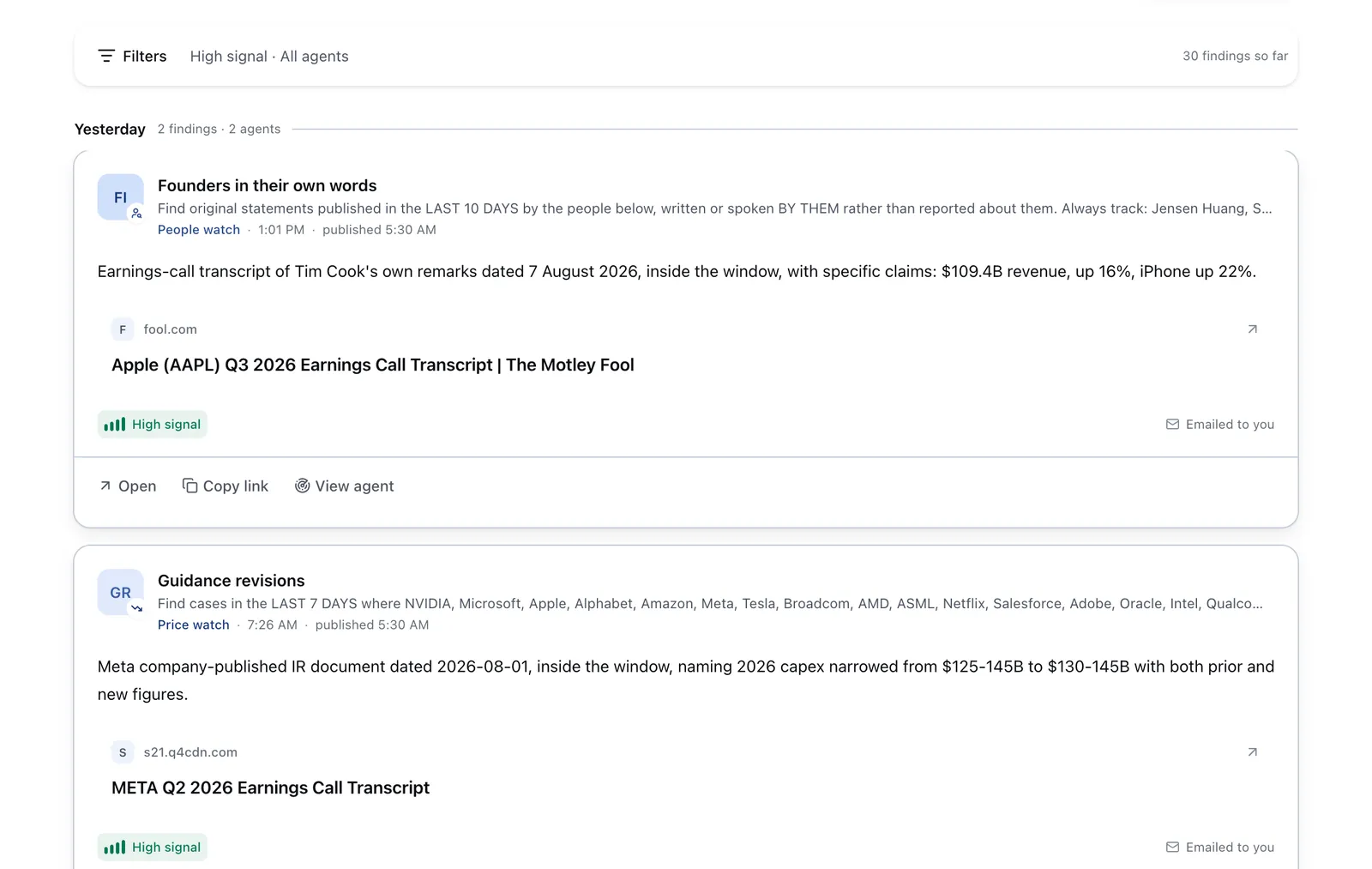
Run it on Parlel
Look for companies hiring into the same function your retainer can temporarily cover.
{"agent":"retainer-gap-watch","schedule":"weekly","filters":{"hiring":true,"size":"11-200","roles":"your_service"},"digest":{"fields":["company","open_roles","buyer_hint","retainer_angle"],"deliver":"retainer_prospect_digest"}}
Digest: company, relevant open roles, likely buyer, and a bounded gap your retainer could cover. Build the watch in Parlel Explore.
Keep reading
Continue the workflow with three closely related guides: - freelance invoice template - how to find freelance clients - how to ask customers for referrals
FAQs
Should retainers bill upfront?
Many providers bill at the start of the coverage period, but the agreement should state the exact date, due date, pause rule, and work-pause consequence.
Should hours roll over?
They can, but define a cap, expiration, and whether rollover is capacity or cash. Unlimited rollover creates an unbounded future obligation.
Is this legal advice?
No. It is a drafting framework. Local counsel should review material, regulated, or cross-border agreements.