Use this template when you need an invoice you can copy, edit, export, and send. Word or Google Docs is convenient for writing, Excel is useful for calculations, and PDF is the normal client-facing final format. Tax rules depend on your location, registration, client location, and service, so the India GST section below is explicitly jurisdiction-specific.
The fastest safe workflow is: copy the text, fill the identity and dates, itemize the agreed work, calculate the subtotal, apply tax only when required, check the due date and payment rail, then export a PDF. Keep the editable Word, Google Docs, or Excel file as your internal master and do not send an accidentally editable copy when the client only needs the final invoice.
TL;DR
- Freelance Invoice Template is a independent work and client operations guide: use it to make one decision, not to collect generic advice.
- Start with the smallest useful version: a defined scope, a payment boundary, and a repeatable operating habit; add complexity only when the evidence requires it.
- Treat every claim as either an observation, an estimate, or a hypothesis; do not present a signal as proof.
- Before you publish or act, check the signed terms, the delivery evidence, and the cash-flow risk.
- The practical outcome is a dated next step, a clear owner, and a reason to stop or revisit the decision.
Copy-ready standard invoice
FREELANCE INVOICE
From: [Name / business] | [Address] | [Email] | [Phone] | [Tax ID if applicable]
To: [Client / company] | [Billing address] | [Accounts-payable email] | [PO]
Invoice no: [INV-ACM-0142]    Issue date: [YYYY-MM-DD]
Service period: [dates]      Due date: [YYYY-MM-DD]
Project / SOW: [reference]

Description                 Qty       Rate        Amount
[Service or milestone]      [ ]       [ ]         [ ]
[Expense, if approved]      [ ]       [ ]         [ ]

Subtotal: [ ]
Tax: [rate and amount, if applicable]
Total due: [currency and amount]
Payment method: [bank / card / UPI / Wise]
Terms: [Net 14, currency, late terms, payment reference]
Notes: [scope, attachments, or approval contact]
The core fields are your identity, the client's identity, a unique number, issue date, service period, itemized work, subtotal, tax treatment, total, due date, payment instructions, and notes. Make line descriptions match the statement of work. AP teams can approve a matching invoice; they often pause a vague one.
Numbering
Use a unique consecutive sequence and retain an invoice ledger. A client prefix such as INV-ACM-0142 is useful operationally, but it is not a universal legal requirement. Do not reuse a number. Mark a voided invoice as VOID and retain it. For India GST invoices, serial-number requirements apply to the relevant financial year; confirm the current rule for your registration.
Which format should you send?
| Situation | Document |
|---|---|
| Completed one-off work | Standard invoice |
| Client needs approval or PO before work | Proforma or quote, clearly labeled |
| A project milestone is reached | Milestone invoice |
| Monthly recurring service | Recurring invoice with coverage period |
| Client wants an editable source | Word or Google Docs master, PDF sent |
| Calculation-heavy work | Excel master, PDF sent |
Proforma invoice
A proforma is generally a preliminary approval or payment document, not automatically a legal tax invoice. Label it PROFORMA, keep it out of the final invoice sequence where your rules require, and issue the applicable final invoice after the service or taxable event. The exact treatment varies by country and tax status.
PROFORMA INVOICE - NOT A TAX INVOICE
Proforma no: [PRO-ACM-0142] | Valid until: [date]
Scope: [project and reference]
Advance requested: [amount]
Balance on delivery: [amount]
Taxes: [as applicable on final invoice]
Payment instructions: [rails]
Filled example math
This example is arithmetic, not tax advice: 10 hours at $80 is $800; an approved $40 expense makes the subtotal $840. If a 10% tax applies, tax is $84 and total due is $924. If no tax applies, total due is $840. Replace every assumption with the contract, jurisdiction, and currency that actually govern the engagement.
India GST note
India's GST Council guidance says there is no single prescribed visual format, but applicable Rule 46 particulars can include supplier details and GSTIN, serial number, issue date, description, HSN or service accounting code, taxable value, tax rate, and tax amount. Place of supply and recipient GSTIN/UIN apply where relevant. Same-state supplies may involve CGST and SGST; inter-state supplies may involve IGST. GST e-invoicing applies only to notified classes meeting conditions, not automatically to every freelancer. Confirm current official notices or ask a tax professional.
Do not copy GSTIN, SAC, tax rates, or place-of-supply fields into an international invoice merely because they appear in an example. US, UK, EU, and other jurisdictions use different rules.
Follow-up schedule
Send the invoice with the agreed reference and attachments. If unpaid, follow up on the due date, then at a cadence permitted by your contract: for example, day 3, day 7, and a final notice. Keep every reminder factual. A clear due date and payment rail matter more than decorative formatting.
Keep a simple ledger with invoice number, client, issue date, due date, currency, amount, paid date, and status. Reconcile the ledger to your bank or payment account. If the client requests a correction, issue a replacement or credit note according to your local rules instead of silently editing an invoice already sent.
Who should not use this template unchanged
Do not use it without review for regulated services, cross-border tax situations, construction or milestone contracts with special requirements, or clients with mandatory procurement fields. Do not call a proforma a tax invoice. Do not add tax simply because another freelancer does; registration and place-of-supply rules control.
Invoice checklist before sending
Run the invoice through the agreement, not through memory. Confirm the legal or trading name, billing address, accounts-payable contact, purchase-order number, project reference, service period, currency, due date, and payment method. Compare each line with the approved scope or milestone. If the client needs a timesheet, acceptance note, or receipt, attach it before sending rather than waiting for a rejection.
| Check | Question |
|---|---|
| Identity | Does the client name match the contract and PO? |
| Numbering | Is this number unique and recorded in the ledger? |
| Scope | Can AP understand what each line paid for? |
| Dates | Is the service period distinct from the issue and due dates? |
| Tax | Is the treatment based on your jurisdiction and status? |
| Currency | Is the currency explicit on rate, subtotal, and total? |
| Payment | Can the client pay without asking for missing bank details? |
| Attachments | Are approvals, receipts, or timesheets included? |
Illustrative example: a designer completes a milestone on October 2. The invoice can state the milestone name, approval reference, service period, fixed fee, applicable tax treatment, due date, and payment rail. It should not imply that a proforma sent before approval was the final tax invoice. The example shows a documentation pattern, not a legal conclusion.
Choose the document by the transaction
Use a quote or proforma when the client needs approval before work or payment. Use a milestone invoice when a contract defines an accepted deliverable. Use a recurring invoice when the agreement defines a monthly service period. Use a credit note, replacement invoice, or other correction process required by local rules when a sent invoice is wrong. Do not quietly alter the PDF and overwrite the ledger; the audit trail matters.
For a retainer, show the coverage period and reference the agreement. If work includes hours, list the included capacity or the period rather than pretending every hour is a separate deliverable. If the client pays an advance, label the document and its tax treatment according to the applicable rules. The retainer agreement template can supply the commercial terms; the invoice should reflect them rather than create new ones.
Tax and cross-border caution
Tax fields are not decorative. Your registration status, client location, place of supply, service classification, currency, and invoicing date can change the required treatment. India GST fields such as GSTIN, HSN or SAC, and place of supply should remain in the India-specific section. A US, UK, EU, or other international invoice may require different information or no tax line at all.
Do not infer tax from the client's country alone. Ask a qualified adviser when the engagement is cross-border, when an intermediary is involved, or when a client requests a treatment you cannot verify. Keep the source of your decision with the invoice record, without placing confidential tax advice in a public template.
Payment follow-up and records
Track issue date, due date, amount, currency, status, and paid date in a ledger. Send one clear reminder on or after the due date, then follow the contract's escalation path. Keep language factual: identify the invoice, amount, due date, and payment instructions. If the client disputes a line, pause the dispute-specific amount only when your contract and local rules support it; do not let a vague objection erase the undisputed record.
Keep the editable master private, export the final PDF, and store the approval trail. A polished invoice cannot repair an unclear scope, but a clear invoice makes an agreed scope easier for a client to approve.
A reusable sending routine
Name the final file consistently, for example invoice-number-client-date.pdf, and check that the PDF opens on a second device. Send it to the agreed accounts-payable address with the project reference in the subject. Save the sent copy, delivery evidence where available, and the ledger update together. This small routine prevents a freelancer from issuing a second invoice simply because the first one is hard to find.
If the client asks for a change after sending, record the request and follow the correction process that applies to your jurisdiction. A revised document should explain what changed and preserve the original reference, rather than creating two apparently valid invoices for one service period.
The freelance invoice template operating standard
This guide is written for a reader who needs to use freelance invoice template in a real workflow, not merely understand the definition. The dependable version starts with the decision that must be made, names the evidence available today, and keeps the next step small enough to complete. That is the editorial standard used throughout this guide and across the Parlel library: practical guidance should help a founder, operator, candidate, or freelancer act without hiding uncertainty behind confident language.
Decide what success means before you start
Write the result in one sentence: “After this exercise, I will know whether , and the next action will be .” For freelance invoice template, that sentence prevents the most common failure mode — doing more research after the useful question has already been answered. If the work concerns a person, company, role, client, or vendor, record the source and date as you go. If it concerns a template or message, define the recipient, context, and desired response before polishing the wording.
Use a small fixture rather than an abstract example. Pick three to five real records, situations, or drafts and run the method end to end. Keep one case that should succeed, one ambiguous case, and one case that should be rejected. That mix exposes whether the process can distinguish a useful signal from a convenient story. It also gives you material for a later review without pretending that a tiny sample is a benchmark.
Make the work explainable to another person
A high-quality result should survive a handoff. Another person should be able to see what was known at the time, which assumptions were made, what action was taken, and what would change the decision. For this topic, preserve the original input alongside the conclusion. Keep a short “why now” note, the owner, the due date, and the stop condition. This makes freelance invoice template useful in an agency-style operating system: the work is repeatable without becoming mechanical, and a reviewer can improve it without rewriting the whole process.
Quality-control pass before you ship
- Intent: Does the page answer the query implied by its title in the first screen?
- Evidence: Are current facts linked to a source, date, or clearly labeled assumption?
- Specificity: Could a reader use the checklist, script, table, or example immediately?
- Boundaries: Does the guide say when the method is a poor fit or should stop?
- Next action: Is there one useful action rather than a pile of competing calls to action?
Those checks matter more than adding another paragraph of general advice. They also protect search quality: the page earns attention by resolving the reader's problem, not by repeating freelance invoice template unnaturally. If the evidence is thin, say so and explain how to improve it. If the answer changes by country, role, plan, or company size, make that branch visible instead of burying it in a footnote.
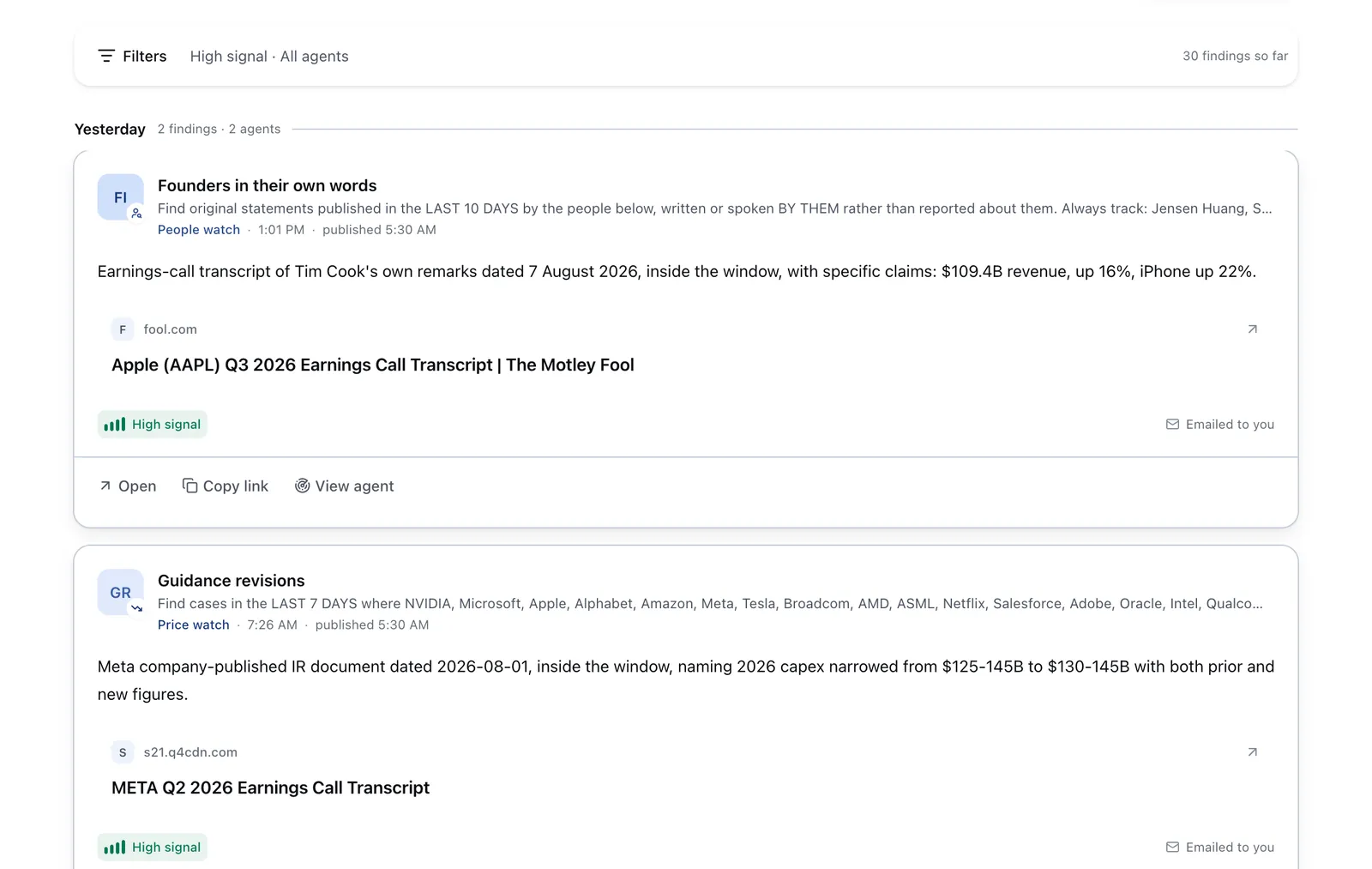
Run it on Parlel
Use paid-client patterns to find similar companies, without uploading confidential invoice details.
{"agent":"invoice-industry-watch","schedule":"monthly","filters":{"hiring":true,"size":"11-200"},"digest":{"fields":["company","industry","open_roles","buyer_hint","service_angle"],"deliver":"prospect_digest"}}
Digest: company, industry, open roles, buyer hint, and a service angle derived from your approved public case-study categories. Review matches in Parlel Explore.
Keep reading
Continue the workflow with three closely related guides: - retainer agreement template - how to find freelance clients - spreadsheet crm template
FAQs
What should a freelance invoice include?
Identity blocks, unique number, dates, service period, itemized work, subtotal, applicable tax, total, due date, payment instructions, and relevant references.
Should I send Word or PDF?
Keep Word or Google Docs as the editable master and send a PDF as the final client copy. Use Excel when calculations are central.
Do all freelancers charge tax?
No. Tax depends on jurisdiction, registration, client location, and service. Check local rules.