Remote hiring is not simply local hiring with a video call. You need a clear outcome, written collaboration habits, a fair assessment, and a lawful way to employ or contract the person where they work. Costs vary by role, geography, benefits, currency, entity, and provider. The numbers below are planning examples, not market facts.
TL;DR
- Hire Remote Developers is a small-team hiring and candidate experience guide: use it to make one decision, not to collect generic advice.
- Start with the smallest useful version: a clear role, a fair process, and a decision that can be explained; add complexity only when the evidence requires it.
- Treat every claim as either an observation, an estimate, or a hypothesis; do not present a signal as proof.
- Before you publish or act, check the role's evidence, the candidate's consent, and the actual working terms.
- The practical outcome is a dated next step, a clear owner, and a reason to stop or revisit the decision.
Choose the engagement model
| Model | Best for | You manage | Main diligence |
|---|---|---|---|
| Direct employee | Long-term core ownership | Day-to-day work and growth | Entity, payroll, benefits, tax |
| Genuine contractor | Defined work with independent method | Deliverable and outcome | Classification, IP, invoices |
| Employer of record | Employee in a country without your entity | Work and performance | Provider terms, local employment |
| Agency or outsourcing | Managed delivery or capacity | Brief and acceptance | Vendor IP, continuity, quality |
| Marketplace freelancer | Short, scoped task | Brief and review | Availability, confidentiality, handoff |
The label does not decide worker status. In the US, the Department of Labor and IRS look at the actual relationship, including control, economic dependence, financial factors, and permanence. Get country-specific legal and tax advice before treating a core, supervised role as a contractor.
The seven-step process
- Write three outcomes. Example: “own the billing data model,” “ship reconciliation,” and “document the on-call path.” Outcomes are more useful than a list of frameworks.
- Publish scope and location. State employment model, overlap window, salary or rate estimate, equity if applicable, and the first-month work.
- Source in the right places. Use your network, startup boards, professional networks, specialist communities, open-source projects, and public directories. LinkedIn, Wellfound, Arc, Toptal, Upwork, and remote boards serve different models and budgets; compare them rather than treating them as interchangeable.
- Run a structured screen. Ask what the candidate personally shipped, how they communicate asynchronously, and what overlap they can sustain.
- Use a job-relevant assessment. A small, paid work sample or discussion of a real system is more relevant than trivia. Cap the time and do not use production code without permission.
- Discuss tradeoffs with the team. Review the work, reasoning, written communication, and collaboration style using the same rubric.
- Reference, offer, and onboard in writing. Explain start date, manager, tools, access, first milestone, and how remote work actually happens.
A decision example
For a pre-launch product where the hardest problem is iterating on one user-facing workflow, a capable full-stack generalist may be sensible. For a product handling payments, sensitive data, or uptime commitments, prioritize someone with backend or platform judgment and add product capacity later. This is a sequencing decision, not a universal rule.
Cost planning without fake benchmarks
Start with a compensation hypothesis from current role postings and country-specific advice, then validate it with candidates. One vendor’s research cited in the brief lists Latin American mid-level developers at $48,000-$72,000 annually versus $87,000-$157,000 for comparable US hires. That is vendor-provided data, not an independent global benchmark. Platform comparisons also report wide hourly ranges, but commercial comparisons are not salary surveys.
Use this worksheet:
cash_or_rate:
employer_taxes_or_provider_fee:
benefits_or_stipend:
equipment:
currency_and_payment_fee:
legal_and_compliance:
work_sample_budget:
total_planning_cost:
Do not add a universal 20-30% loading factor. Ask an accountant or EOR for the country-specific cost. Put salary or rate assumptions, payment currency, review timing, and who bears transfer fees in writing.
Assess remote work fairly
Ask the candidate to explain a recent decision in writing, then discuss it live. Look for clear status updates, sensible tradeoffs, questions asked early, and the ability to make progress without constant supervision. Use the same core exercise and time cap for comparable candidates; accommodate accessibility needs.
Onboarding is part of the hire
Before day one, prepare access, a written product map, a named buddy, communication norms, and a first task that can be completed without archaeology. Define when to use chat, tickets, docs, and meetings. A remote engineer should not need to infer the team’s working hours from who happens to answer.
Compare the hiring paths honestly
The fastest-looking path can create the most work later. Decide what you are buying: a person joining your team, a defined outcome delivered by an independent business, or capacity managed by a vendor. The answer affects control, continuity, IP, security, and the obligations that apply where the worker lives.
| Need | Likely fit | Questions to resolve |
|---|---|---|
| Long-term product ownership | Direct employee or EOR employee | Entity, payroll, benefits, IP, manager |
| Defined independent project | Genuine contractor | Scope, independence, acceptance, classification |
| Short-term capacity | Agency or staff augmentation | Who manages the person, replacement, IP |
| No local entity | EOR or local setup | Provider contract, local employment, fees |
| Small experiment | Paid scoped engagement | Data access, handoff, decision date |
This is a decision aid, not a legal classification. If the person works core hours under your direction, uses your systems, and performs an ongoing integral role, ask counsel to assess whether the proposed model reflects the facts.
A fair technical process
Use the job description to create a scorecard before reviewing candidates. For each outcome, define what evidence would be strong, acceptable, or missing. Ask candidates to explain work they actually performed, including constraints and tradeoffs. A public repository may show contribution but not ownership; a polished portfolio may show presentation but not maintenance.
An assessment should be relevant, time-bounded, and paid when it produces meaningful work for the company. Do not ask candidates to solve a live production problem, disclose a former employer’s confidential code, or complete an unpaid project that substitutes for delivery. Offer an alternative for accessibility needs and keep the same core rubric for comparable candidates.
| Evidence | Strong signal | Follow-up |
|---|---|---|
| System explanation | Names decisions, constraints, and failure modes | What did you personally change? |
| Written update | Clear status, risk, and next decision | How would you escalate this? |
| Work sample | Solves the role’s problem within the time box | What would you defer in production? |
| Collaboration example | Explains disagreement and outcome | What changed your view? |
| Reference | Specific observed behavior | What support helped them succeed? |
Illustrative hiring choices
Illustrative scenario, not a benchmark: A pre-launch product needs rapid iteration on one customer-facing workflow and has no complex compliance burden. A full-stack generalist may be the best first hire if the role clearly owns the vertical slice and can work with the founder. A payments product with sensitive data and uptime commitments may instead prioritize backend or platform judgment, incident experience, and security habits before adding more interface capacity. Neither choice follows from a title alone; product risk and first outcomes determine the need.
Remote-work questions candidates should not have to guess
Publish the countries or regions you can employ, the employment model, salary or rate currency, overlap window, travel expectations, equipment policy, benefits, and who handles local paperwork. Say whether the team is async-first or meeting-heavy. Explain how decisions are documented, how incidents are handled, and how a new engineer gets help.
For international candidates, do not promise that an EOR solves every tax, IP, data-protection, or immigration issue. Ask the provider and local counsel what is covered. Keep candidate data limited to the hiring purpose, restrict access to people who need it, and follow applicable retention and privacy rules.
Remote hiring checklist
- Define three role outcomes and the first-month milestone.
- Choose the employment or delivery model before sourcing.
- Publish location, overlap, compensation, and process clearly.
- Build a role-linked scorecard and consistent interview questions.
- Verify public work without inferring sensitive personal facts.
- Use a paid, job-relevant assessment when appropriate.
- Obtain references with consent and separate verification from performance evidence.
- Confirm classification, IP, security, payroll, and benefits for the work location.
- Send written terms that match the published role.
- Prepare access, documentation, a buddy, and a first useful task before day one.
Make the first month observable
Remote hiring often fails after the offer because “remote” was treated as a location rather than an operating system. Write down where decisions live, how priorities change, how progress is reported, and when a person should ask for help. The manager should define the first-month outcome in a way that can be reviewed asynchronously.
| Before day one | First week | First month |
|---|---|---|
| Account access and equipment | Product and architecture map | First meaningful outcome |
| Manager, buddy, and contacts | One small change shipped or reviewed | Written tradeoff or design note |
| Security and data boundaries | Communication and escalation norms | Feedback and next-scope decision |
| Time-zone and meeting rules | Local development path | Updated onboarding documentation |
Do not require constant online presence as a proxy for output. At the same time, do not leave availability undefined for incidents, customer support, or collaboration windows. Candidates should know whether the team values asynchronous written work, scheduled overlap, or both.
Offer transparency by model
An employee, contractor, agency worker, and EOR employee may all be described casually as a “remote developer,” but the candidate needs different information for each. State who pays them, who manages them, who owns the work, what benefits exist, how termination works, and what happens to access and deliverables when the engagement ends. If a provider is involved, say which obligations sit with the provider and which remain with the company.
For cross-border work, check local payroll, social contributions, leave, working-time rules, data transfer, IP enforceability, and immigration requirements where relevant. Do not rely on a generic provider blog as legal advice. Keep a dated record of the country reviewed and the professional advice received.
Hiring review checklist
- Write outcomes, constraints, and first-month evidence.
- Choose the model based on the relationship, not speed alone.
- Publish country, overlap, compensation, benefits, and process.
- Source from relevant networks and verify actual work.
- Use consistent, accessible, job-related assessment.
- Ask consent-based references and separate verification from judgment.
- Review classification, tax, payroll, IP, security, and privacy.
- Keep candidate data restricted and retention-limited.
- Align the offer, role page, and formal agreement.
- Treat onboarding documentation as part of the hiring work.
The hire remote developers operating standard
This guide is written for a reader who needs to use hire remote developers in a real workflow, not merely understand the definition. The dependable version starts with the decision that must be made, names the evidence available today, and keeps the next step small enough to complete. That is the editorial standard used throughout this guide and across the Parlel library: practical guidance should help a founder, operator, candidate, or freelancer act without hiding uncertainty behind confident language.
Decide what success means before you start
Write the result in one sentence: “After this exercise, I will know whether , and the next action will be .” For hire remote developers, that sentence prevents the most common failure mode — doing more research after the useful question has already been answered. If the work concerns a person, company, role, client, or vendor, record the source and date as you go. If it concerns a template or message, define the recipient, context, and desired response before polishing the wording.
Use a small fixture rather than an abstract example. Pick three to five real records, situations, or drafts and run the method end to end. Keep one case that should succeed, one ambiguous case, and one case that should be rejected. That mix exposes whether the process can distinguish a useful signal from a convenient story. It also gives you material for a later review without pretending that a tiny sample is a benchmark.
Make the work explainable to another person
A high-quality result should survive a handoff. Another person should be able to see what was known at the time, which assumptions were made, what action was taken, and what would change the decision. For this topic, preserve the original input alongside the conclusion. Keep a short “why now” note, the owner, the due date, and the stop condition. This makes hire remote developers useful in an agency-style operating system: the work is repeatable without becoming mechanical, and a reviewer can improve it without rewriting the whole process.
Quality-control pass before you ship
- Intent: Does the page answer the query implied by its title in the first screen?
- Evidence: Are current facts linked to a source, date, or clearly labeled assumption?
- Specificity: Could a reader use the checklist, script, table, or example immediately?
- Boundaries: Does the guide say when the method is a poor fit or should stop?
- Next action: Is there one useful action rather than a pile of competing calls to action?
Those checks matter more than adding another paragraph of general advice. They also protect search quality: the page earns attention by resolving the reader's problem, not by repeating hire remote developers unnaturally. If the evidence is thin, say so and explain how to improve it. If the answer changes by country, role, plan, or company size, make that branch visible instead of burying it in a footnote.
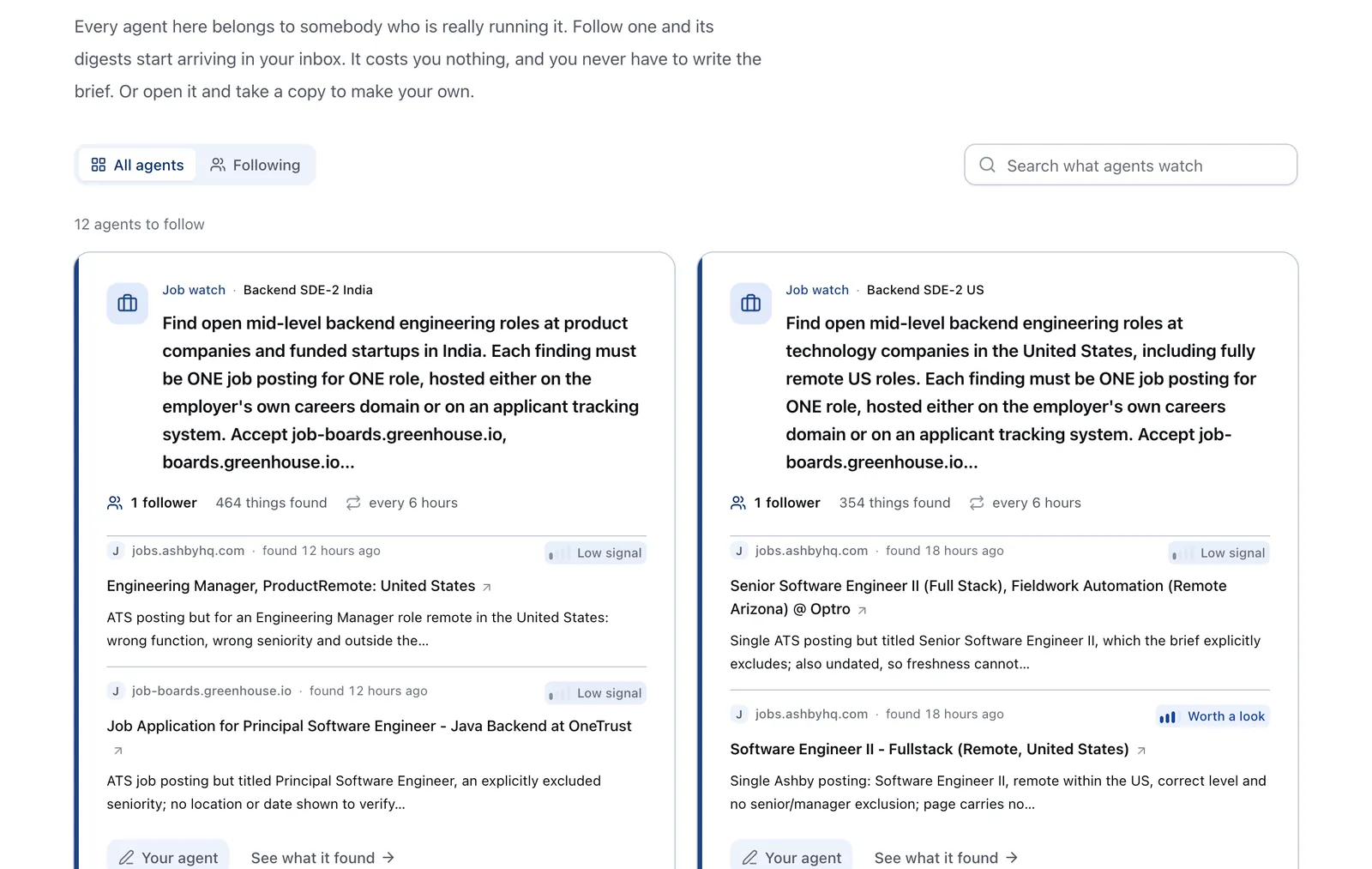
Run it on Parlel
Use a skill and availability search to create a human-reviewed shortlist.
REMOTE ENGINEER SEARCH
- skills: [typescript, postgres, queues]
- seniority: senior or staff
- arrangement: employee | contractor | EOR
- overlap: [time window and minimum hours]
- evidence: profile, role history, public work
- deliver: max 10 profiles weekly, human review required
Verify profiles in the people directory, publish the role from the job description template, and use contract-to-hire only when the uncertainty is genuine.
Keep reading
Continue the workflow with three closely related guides: - contract to hire - job description template - sourcing passive candidates