A passive candidate is not actively applying but may consider the right opportunity. The job is not to trick someone into a funnel. It is to find relevant evidence, explain the opportunity plainly, and make it easy to decline. SHRM and Workable guidance both emphasize clear staffing needs, skill-based sourcing, tailored engagement, and a simple candidate experience.
TL;DR
- Sourcing Passive Candidates is a small-team hiring and candidate experience guide: use it to make one decision, not to collect generic advice.
- Start with the smallest useful version: a clear role, a fair process, and a decision that can be explained; add complexity only when the evidence requires it.
- Treat every claim as either an observation, an estimate, or a hypothesis; do not present a signal as proof.
- Before you publish or act, check the role's evidence, the candidate's consent, and the actual working terms.
- The practical outcome is a dated next step, a clear owner, and a reason to stop or revisit the decision.
Define the target before searching
Write the outcome, must-have skills, domain evidence, location or time-zone constraint, employment model, salary or rate range, and what is learnable. “Senior engineer” is not enough. “Own a Postgres billing ledger, write incident documentation, and work four hours overlapping UTC” is searchable and honest.
Where to look
Use professional networks, specialist communities, conferences, alumni groups, open-source projects, technical writing, referrals, past finalists, and public people directories. Search for shipped work rather than a title alone. A title can be useful context; it is not proof of scope.
Boolean examples
(Postgres OR PostgreSQL) AND (billing OR payments) AND (fintech)
(Go OR Golang) AND (Kafka OR queues) AND (migration OR incident)
-recruiter -staffing
site:github.com (maintainer OR contributor) (rust OR go)
(database OR infrastructure)
Syntax and visibility vary by platform. Test one constraint at a time and record where the query works. Verify a relevant project, talk, repository, or technical article before writing.
A short screen, labeled as a heuristic
The research does not establish a universal time limit. Use a short time-box only as a proposed founder workflow:
- Relevance: does visible work overlap the role’s outcomes?
- Trajectory: has responsibility expanded, or is the context at least comparable?
- Specificity: can you point to what the person actually owned?
Advance someone who clears all three, keep a thoughtful “uncertain” list when public evidence is thin, and reject when the role is plainly unrelated. Do not infer sensitive personal facts from a profile.
First message and one follow-up
Hi [Name] — your [project/post/talk] about [specific evidence] is relevant to
what we are building. I am hiring for [role] to own [outcome], with [location,
band or rate] and [working model]. Would you like the short brief? No pressure
if the timing is wrong.
After a reasonable interval, send one new fact:
One useful detail: the first 90 days are [specific scope], and the team is
[honest context]. If that is not interesting, no reply is needed and I will
not follow up again.
Do not claim you read work you did not read. Provide an opt-out. Do not send a current employer a surprise reference request. Respect community and platform rules, and keep outreach volume small enough to research each person.
Candidate-source tracker
candidate | source | evidence_url | skills | domain | location/overlap
role_fit | message_date | reply | screen | work_sample | offer | hire
opt_out | next_action | next_action_date | notes
Compare sources by qualified screens, work samples, offers, hires, time spent, and candidate experience. Reply rate alone can reward curiosity rather than fit. Use your own dated cohorts rather than importing a reply-rate or contacted-per-hire promise from another market.
Build an evidence-first shortlist
Search for work that overlaps the role, not just a title that resembles it. A candidate may have relevant ownership under a different title, while a matching title may hide a very different scope. For each person, record the exact evidence, its date, and what it does not establish.
| Evidence | May support | Does not establish |
|---|---|---|
| Maintained repository | Technical exposure and contribution | Sole ownership or production responsibility |
| Technical article or talk | Ability to explain a topic | Current availability or depth in every area |
| Role history | Context and trajectory | Quality of every project |
| Referral | Relationship and relevance | Permission to contact others |
| Public job change | Possible context | Dissatisfaction or openness to move |
Keep an “uncertain” state. Forcing a yes or no from thin public evidence creates bias and encourages outreach based on assumptions.
A respectful sourcing sequence
- Define outcomes, must-have skills, location, employment model, and range.
- Search two or three relevant sources and record the query that worked.
- Verify one concrete project, article, talk, or role history.
- Check that the role can be offered where the person works.
- Draft a message that names the evidence and states the actual scope.
- Offer the short brief and make declining easy.
- Send one follow-up with new information, then stop unless invited to continue.
- Record reply, opt-out, source, and next action.
The sequence is an operating recommendation, not a universal cadence. A candidate who says “not now” may welcome a future role, but only if they tell you that or you have a clearly appropriate future trigger.
Illustrative search example
Illustrative scenario, not a benchmark: A founder needs an engineer to own a Postgres billing ledger for a fintech workflow. The search begins with (Postgres OR PostgreSQL) AND (billing OR payments) AND (fintech). The founder verifies a relevant migration or technical explanation, checks the candidate’s location and the role’s overlap window, and sends the scope, range, and working model. A person who contributed to a public repository is not described as its maintainer unless the source supports that claim.
If the search returns too many people, add one constraint at a time. If it returns almost nobody, revisit whether the domain is truly required or whether the role can teach it. Search syntax and profile visibility vary by platform, so keep the query and result quality in your notes.
Candidate experience and privacy
Passive outreach is an interruption. Tell the person why you selected them, what the role owns, how it works, and what compensation or rate information is known. Do not hide the company, disguise recruiting as research, or ask for confidential work from a current employer. Do not infer family status, health, age, ethnicity, immigration status, or other sensitive attributes from a public profile.
Limit stored candidate data to the hiring purpose, restrict access, and honor deletion or suppression requests where applicable. If a person opts out, suppress the profile from future campaigns. A public profile is not blanket consent for every channel or for sharing their information internally.
Sourcing failure modes
- A title filter excludes strong candidates with adjacent titles.
- A public project is treated as proof of sole ownership.
- The message praises work the sender did not read.
- The compensation or location is withheld until late in the process.
- A recruiter or founder keeps following up after a clear no.
- A source produces many replies but few qualified screens, and is judged successful anyway.
- An AI tool creates a confident summary from stale or merged profiles.
Passive-sourcing checklist
- Publish the role or canonical brief before contacting people.
- Define evidence and must-have requirements in a scorecard.
- Search relevant communities, referrals, work samples, and public directories.
- Verify one concrete piece of work per shortlisted person.
- Keep uncertain candidates separate from rejected candidates.
- State scope, location, working model, and range in the first serious message.
- Provide an opt-out and honor it.
- Compare sources by qualified screens, offers, hires, time, and candidate experience.
- Protect candidate data and do not infer sensitive facts.
- Review the shortlist for title, geography, and network bias before sending.
Improve the shortlist after each batch
Review both the people you contacted and the people you rejected. If most replies come from candidates outside the intended scope, the query may be too broad. If strong candidates do not reply, the role may be unclear, the channel may be inappropriate, or the opportunity may not be compelling. Do not assume a new automation tool is the answer before checking the role brief and evidence standard.
Keep a small sample of rejected profiles with the rejection reason: unrelated work, no location coverage, missing essential evidence, duplicate, opt-out, or insufficient information. This makes later review possible without repeatedly researching the same people. Delete or restrict information according to your privacy policy and applicable law.
For diverse sourcing, inspect the search inputs and network effects rather than applying a demographic guess to individuals. Expand communities, schools, open-source projects, and referral routes that are genuinely relevant to the work. Never infer a protected characteristic from a name, photo, location, or group membership.
Message review before contact
Ask another person to check one or two messages for factual accuracy, clarity of intent, range, location, and opt-out language. The reviewer should be able to answer why this person was selected from the record alone. If the message depends on a private fact, delete that personalization. If the role cannot be explained without a long pitch, improve the job description first.
Sourcing review checklist
- Keep a dated query and evidence URL.
- Record why each person fits and what remains unknown.
- Check role location, employment model, range, and overlap.
- Review the message for false personalization.
- Provide a clear opt-out and stop on a no.
- Suppress prior opt-outs and recent contacts.
- Compare source quality through qualified outcomes.
- Remove sensitive or unnecessary data from the tracker.
Before the first message
Ask a colleague to check the role brief and one or two messages for factual accuracy, clarity of intent, compensation, location, and opt-out language. The reviewer should be able to explain why the person was selected from the record alone. If the message depends on a private fact, delete that personalization. If the role cannot be explained without a long pitch, improve the job description first.
Keep the shortlist useful after the campaign ends. Record whether a person was contacted, declined, opted out, changed roles, or remained uncertain. Suppress opt-outs and avoid treating public availability as known unless the candidate says so. This keeps later Parlel searches from turning stale or unwanted contact into a new campaign.
The sourcing passive candidates operating standard
This guide is written for a reader who needs to use sourcing passive candidates in a real workflow, not merely understand the definition. The dependable version starts with the decision that must be made, names the evidence available today, and keeps the next step small enough to complete. That is the editorial standard used throughout this guide and across the Parlel library: practical guidance should help a founder, operator, candidate, or freelancer act without hiding uncertainty behind confident language.
Decide what success means before you start
Write the result in one sentence: “After this exercise, I will know whether , and the next action will be .” For sourcing passive candidates, that sentence prevents the most common failure mode — doing more research after the useful question has already been answered. If the work concerns a person, company, role, client, or vendor, record the source and date as you go. If it concerns a template or message, define the recipient, context, and desired response before polishing the wording.
Use a small fixture rather than an abstract example. Pick three to five real records, situations, or drafts and run the method end to end. Keep one case that should succeed, one ambiguous case, and one case that should be rejected. That mix exposes whether the process can distinguish a useful signal from a convenient story. It also gives you material for a later review without pretending that a tiny sample is a benchmark.
Make the work explainable to another person
A high-quality result should survive a handoff. Another person should be able to see what was known at the time, which assumptions were made, what action was taken, and what would change the decision. For this topic, preserve the original input alongside the conclusion. Keep a short “why now” note, the owner, the due date, and the stop condition. This makes sourcing passive candidates useful in an agency-style operating system: the work is repeatable without becoming mechanical, and a reviewer can improve it without rewriting the whole process.
Quality-control pass before you ship
- Intent: Does the page answer the query implied by its title in the first screen?
- Evidence: Are current facts linked to a source, date, or clearly labeled assumption?
- Specificity: Could a reader use the checklist, script, table, or example immediately?
- Boundaries: Does the guide say when the method is a poor fit or should stop?
- Next action: Is there one useful action rather than a pile of competing calls to action?
Those checks matter more than adding another paragraph of general advice. They also protect search quality: the page earns attention by resolving the reader's problem, not by repeating sourcing passive candidates unnaturally. If the evidence is thin, say so and explain how to improve it. If the answer changes by country, role, plan, or company size, make that branch visible instead of burying it in a footnote.
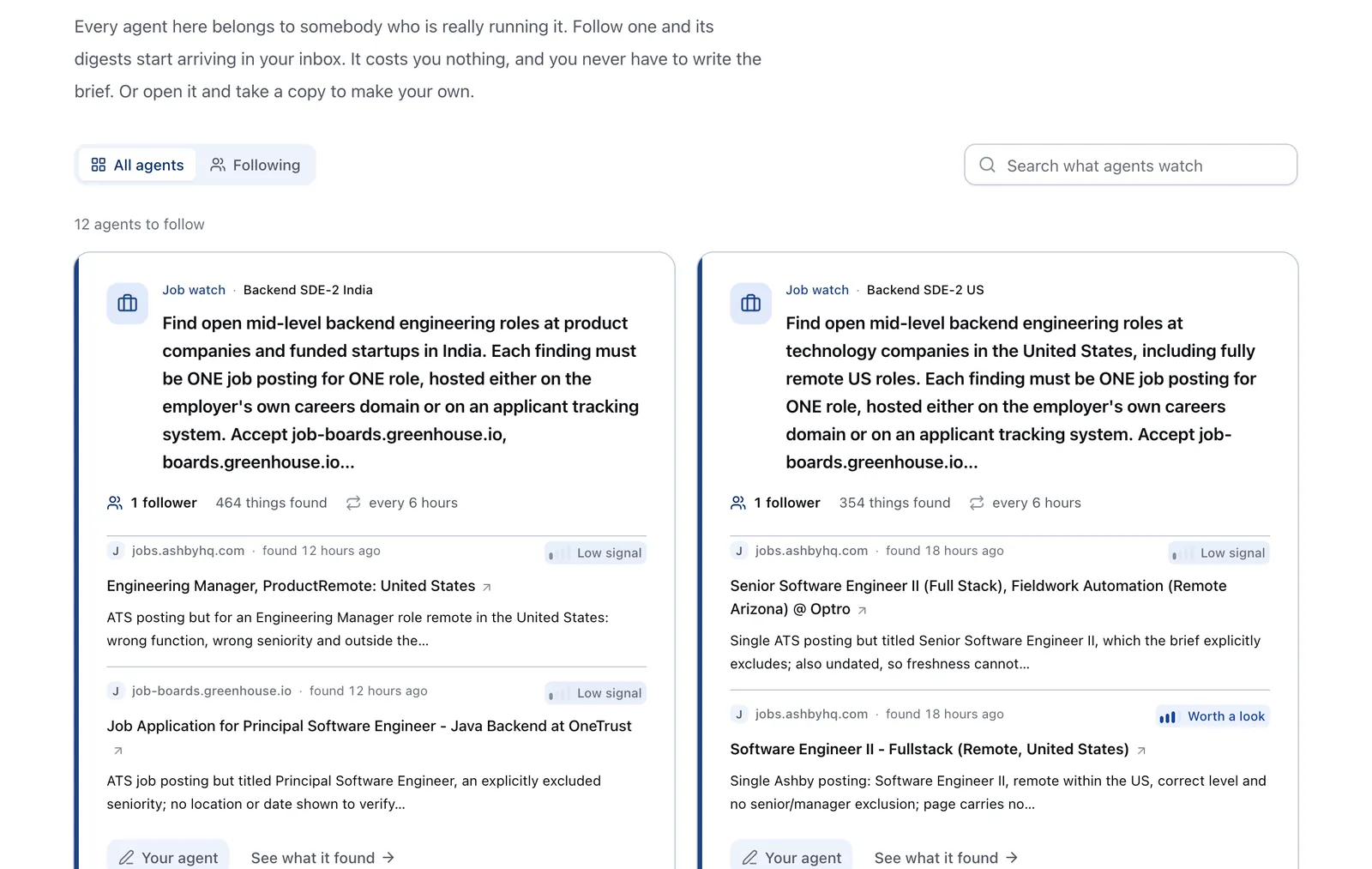
Run it on Parlel
Use a standing search as a shortlist generator, not an auto-contact system.
PASSIVE SEARCH
- skills: [go, postgres, kafka]
- seniority: [senior, staff]
- location: [remote overlap window]
- evidence_required: public work or role history
- exclude: contacted_within_90_days, opt_out
- deliver: 12 profiles weekly, ranked by evidence overlap
- action: founder_review_before_message = true
Open each people directory profile, verify evidence, and link the canonical job description. Keep availability unknown when it is unknown; “not open to work” is not a rejection.
Keep reading
Continue the workflow with three closely related guides: - hire remote developers - job description template - contract to hire