A thank-you email after an interview is a small piece of professional follow-through. It cannot repair a poor fit or guarantee a decision, but it gives you a clear way to show appreciation, record one useful connection from the conversation, and make any necessary clarification without reopening the whole interview.
TL;DR
- Send it within 24 hours. If the interview ends late or before a weekend, the next business morning is reasonable.
- Include appreciation, one specific callback, one relevant qualification or contribution, and a professional close.
- Send separate notes when practical, using a different detail for each interviewer.
- Clarify one incomplete answer only when the clarification is useful and factual; do not rewrite the interview.
- Keep the thank-you note separate from a status chase. If no timeline was given, a brief check-in after roughly five business days to one week is reasonable.
What the note can and cannot do
A thank-you email can make the conversation easier to recall and can show that you listened. SHRM, UC Davis, and Boston University career guidance all recommend a concise note with a specific detail, but that advice is etiquette guidance, not proof that the message changes a hiring decision. Robert Half reported that 27% of surveyed U.S. hiring managers said a thank-you message could positively affect a decision between candidates with equal skills and experience; that survey is not a guarantee and should not be turned into an offer-rate claim.
The note is low effort, but it should still be accurate and proportionate. This guide pairs with our job application follow-up timeline for what happens after the note and our interview questions and answers bank for preparation.
Interview thank you email: timing, length, and structure rules
Interview thank you email mechanics in one pass. Timing: within 24 hours, same-evening preferred; for panel interviews, email each interviewer separately within the same window. Length: 120–180 words — readable on a phone between meetings. Structure: subject line with your name and role ("Thank you — Backend Engineer interview, Aarav Sharma"), one line of genuine thanks naming something specific, one paragraph connecting your background to their stated problem, optional two-line repair of a weak answer, and a forward-looking close.
Tone calibration matters: warm but not gushing, confident but not presumptuous. Never ask "did I get the job" or demand timelines; "I'm excited about the onboarding challenge you described and would welcome next steps" carries the same energy without pressure. Never attach new documents unless requested — link a portfolio or writing sample inline at most. And proofread twice: a typo in a thank-you note undoes the conscientiousness the note exists to prove.
Template 1: the standard same-day thank-you
The workhorse — use after any single interviewer round that went reasonably well. Personalise the bracketed lines; keep everything else. Whether you think of it as an email or a formal thank you letter after interview, hiring managers treat both identically: specificity and speed are what get scored.
Subject: Thank you — [Role] interview, [Your Name]

Hi [Name],

Thank you for your time today — I particularly enjoyed our
discussion about [specific topic, e.g. how the team handled
the payments migration without downtime].

Our conversation confirmed my interest: [one line linking your
background to their problem, e.g. my two years on billing
infra map directly onto the reliability push you described].

[Optional repair, max 2 lines: On reflection, a sharper answer
to your question on [X] would have been [Y].]

I'd welcome the chance to continue — please let me know if
anything else would be helpful from my side.

Best,
[Your Name] | [phone] | [portfolio/profile URL]
Why it works: specific callback proves attention, the linking line re-sells fit without repeating the resume, and the close invites next steps. This single template covers most rounds; the variants below handle special cases. General interview-preparation principles behind it are detailed in our interview bank.
Template 2: panel interviews (one per interviewer)
Panels compare notes — including your notes. Send each interviewer a distinct email within the same evening, each referencing something only that person discussed. The skeleton stays constant; the middle paragraph rotates.
Subject: Thank you — [Role] panel, [Your Name]

Hi [Name],

Thanks for the [system design / culture / hiring-manager]
conversation today. Your point about [their specific topic]
gave me a lot to think about — [one line of genuine reaction
or relevant experience, e.g. we faced the same queue-backlog
problem and solved it with partitioned consumers].

I'm excited about [team/company mission in their words], and
I'd love to contribute [your specific skill] to it.

Best,
[Your Name] | [phone]
Example rotation for a three-person panel: the engineer gets your technical reaction, the manager gets your ownership anecdote, and the HR round gets your culture-and-logistics question. Identical copy-paste can feel impersonal. If you do not have time to write separate notes, send one accurate message to the coordinator or lead interviewer rather than inventing different details.
Template 3: repairing a weak answer gracefully
Everyone flubs one question. The repair template addresses it head-on — briefly, without grovelling — and replaces the memory with the answer you wish you gave.
Subject: Thank you — and a sharper answer on [topic]

Hi [Name],

Thank you for today's conversation on [role] — the discussion
around [specific topic] was exactly the kind of problem I
enjoy.

One follow-up from my side: on reflection, my answer to your
question about [X] was less crisp than it should have been.
What I should have said: [2–3 line corrected answer with a
metric or decision, e.g. we cut onboarding drop-off 8 points
by moving verification after the aha-moment, not before].

Appreciate the thoughtful questions — happy to dig deeper
in the next round.

Best,
[Your Name] | [phone]
Rules: repair at most one answer (two reads as damage control), keep the correction short and factual, and never blame nerves. Interviewers respect self-correction — it mirrors the code-review and retrospectives culture good teams run daily.
Template 4: second and final rounds (escalating enthusiasm)
Later rounds need rising conviction, not repeated introductions. Reference accumulated understanding across rounds and name the future explicitly.
Subject: Excited about [Role] — thank you, [Name]

Hi [Name],

After today's [final/round-N] conversation, my enthusiasm has
only grown. Across rounds, three things stand out: [their
problem 1], [how the team thinks about 2], and [the growth
  direction in 3] — all squarely where I do my strongest work.

If I joined, my first-90-days focus would be [one concrete
proposal tied to what you learned, e.g. instrumenting the
trial funnel before touching copy].

Thank you for the process so far — I'm keen on next steps.

Best,
[Your Name] | [phone]
The 90-day line is optional. Keep it to one modest proposal grounded in what you learned, not a consultancy report. Salary-stage readiness after finals is covered in our negotiation guide.
Template 5: post-rejection grace note
The note is optional, but it can close the process respectfully and leave the door open if the employer genuinely invites future contact.
Subject: Thank you — [Role] process

Hi [Name],

Thank you for letting me know, and for the thoughtful process.
[One genuine line: e.g. the system-design round was one of the
most useful conversations I've had this year.]

If a [adjacent skill area] role opens, I'd welcome being
considered — I'll be following [company]'s [launch/blog]
with interest either way.

[Optional: one-line update hook, e.g. I'm shipping a side
project in your stack; happy to share when live.]

Best,
[Your Name] | [profile URL]
Do not assume a rejection means “not now,” or that a future role will appear. Send the note because it is courteous, not because a future offer is guaranteed.
Template 6: recruiter and referral thank-you (the network variant)
Recruiters and referrers are repeat players — thank them in ways that invest in the relationship beyond one role.
Subject: Thank you for the [Company] intro, [Name]

Hi [Name],

Quick thanks — [your conversation / the interview loop at
Company] went well, and I appreciate you [making the intro /
prepping me / championing my profile].

[One line on status: e.g. I'm through to finals; I'll keep
you posted.] Regardless of outcome, I'd value staying in
touch — [one line of mutual interest, e.g. your fintech
placements are exactly my lane].

Grateful,
[Your Name] | [phone]
Referrers especially deserve closure: tell them the outcome either way, since their reputation rode on your introduction. This is also how referral networks grow — today's thanked referrer makes tomorrow's warmer intro. Our cover letter format guide covers the adjacent skill of written self-presentation for cold applications.
Mistakes that sink good intentions
Seven practical pitfalls: waiting several days, sending identical panel emails, asking for a decision in the thank-you note, attaching unrequested work, gushing, misspelling names, and ignoring the coordinator who organized the process. If the interview went badly, a concise and honest note is still possible; do not use it to argue with the evaluation.
A fast personalization worksheet
Write these four lines immediately after the interview, before the details blur:
| Note | Your answer |
|---|---|
| Specific detail | What problem, decision, or question did they explain? |
| Relevant evidence | Which true experience connects to it? |
| Open question | Is there one answer that needs a factual clarification? |
| Next step | What timeline or action did they actually state? |
This worksheet prevents the most common generic sentence: “I enjoyed learning more about the company.” Replace it with a real callback. Illustrative example: “Your plan to shorten onboarding by two weeks connected directly to my process-documentation work.” The example is useful only if the interviewer actually discussed that plan and the candidate has done the claimed work.
Scenario decision table
| Situation | Send | Avoid |
|---|---|---|
| Recruiter screen | Thanks, role interest, and one fit point | A technical essay the recruiter cannot evaluate |
| Video interview | Same concise note as in person | Mentioning technology problems as the main topic |
| Technical round | One design or trade-off you discussed | Attaching unrequested code or correcting every answer |
| Portfolio review | Specific reaction to the work and contribution | Re-sending the entire portfolio |
| Large panel | Separate notes when practical, or one accurate lead note | Inventing different details for people you barely met |
| Late note | Acknowledge the delay briefly and be sincere | An elaborate excuse or demand for forgiveness |
The medium does not change the principle. Video, phone, and in-person interviews all deserve a message grounded in what happened. If you do not have a person’s address, ask the recruiter or coordinator. Do not guess an email pattern or add someone on a social platform as a substitute.
Country and role calibration
Tone and logistics vary by context, but clarity travels well. For an India-based process, a note may briefly confirm notice period or location only if it was relevant and accurate; do not turn gratitude into compensation negotiation. For EU and UK processes, use the interviewer’s name and the level of formality they used, and avoid attaching personal information that was not requested. For US startup processes, a concise note can mention a concrete first contribution, but it should not promise a 90-day transformation without enough context.
Role-specific callbacks are stronger than generic enthusiasm. An engineer can reference a reliability trade-off, a product candidate a discovery tension, a sales candidate a customer segment, and an operations candidate a process constraint. A fresher can reference what they learned and the project they would be ready to discuss. A senior candidate can name the decision or operating problem they would help own. In every case, write only what you can support.
Clarification versus damage control
Send a clarification when one incomplete answer contains relevant, factual information that could change how the interviewer understands your experience. Keep it to two or three lines. Do not send a second note for every answer you wish had sounded better, and do not attach a long case study to prove you were right.
Illustrative example: “After reflecting on your question about onboarding, I wanted to add one detail: I moved verification after the first product success moment, which reduced drop-off by eight points in the measured experiment.” This works only if the candidate owns the result and can explain the baseline and period. “I should have answered better” without useful information does not require a follow-up.
Status follow-up without pressure
The thank-you note and the status check have different jobs. The first acknowledges the conversation; the second asks what happens next after the stated timeline. If no timeline was given, a brief check-in after roughly five business days to one week is reasonable. Mention continued interest, ask whether the timeline has changed, and offer any requested information. Send once, then continue your search rather than treating silence as an invitation to escalate.
Do not ask about salary, benefits, or a decision in the thank-you email unless the interviewer explicitly made that the next topic. Do not use a note to argue with feedback or pressure a coordinator. The most persuasive follow-through is calm, specific, and proportionate to the stage.
Privacy and record keeping
Keep interview notes private and remove confidential company information from any AI drafting prompt. Do not paste a take-home assignment, internal roadmap, or interviewer’s personal details into a public tool. If you use AI to clean up a draft, supply only the minimum context and inspect every sentence. Preserve your own voice; a message that sounds unlike you may create more doubt than a short imperfect note.
Record the date sent, recipient, promised timeline, and next action in a private tracker. That record is useful for follow-up and prevents sending a second “thank you” by mistake. It also helps you compare processes as a candidate without turning a courtesy email into a fabricated performance experiment.
Thank-you email subject lines that get opened
These thank you email interview subject lines use a simple formula: gratitude + role + your name. Examples: "Thank you — Backend Engineer interview, Aarav Sharma", "Great speaking today — Product Designer loop, Priya Nair", and "Following up with one sharper answer — Data Analyst round, Rohan Mehta". Clear context helps the recipient identify the thread.
What to avoid: vague lines ("Thank you!"), desperate lines ("Really really want this job"), clever claims, salary or benefits questions, pressure for a decision, exaggerated fit, and unsolicited attachments. For panel members, add the round context and use a different accurate detail where possible.
Re-engaging after silence: the one-month value note
Sometimes the process goes quiet after an interview because priorities shift or the thread is delayed. If the employer’s stated timeline has passed, send one brief value-adding follow-up: continued interest, one new relevant artifact or observation, and a zero-pressure question about timing.
Example skeleton: "Hi [Name] — saw the [launch] last week; the [specific detail] connects with the problem we discussed. Since we spoke I’ve [shipped X / published Y]. I remain interested and would appreciate any update when timing is clear." Send once; if silence persists, archive with grace.
Thank-you notes for recruiters and coordinators
Interviewers are not the only audience. The recruiter or coordinator who scheduled your rounds deserves a short parallel note — they control process velocity and often carry informal influence on sentiment. Keep it lighter than interviewer notes: thanks for coordination, one line of enthusiasm about the team, and a clear statement of availability for next steps. Name one concrete detail from the process (the panel's punctuality, a well-run exercise) so the note reads as observant rather than perfunctory. If an external recruiter championed you, this note doubles as relationship maintenance for future searches. And when timelines slip, the coordinator gets the polite nudge instead of the hiring manager — protecting senior attention while keeping your thread warm is exactly the political judgement startups hire for.
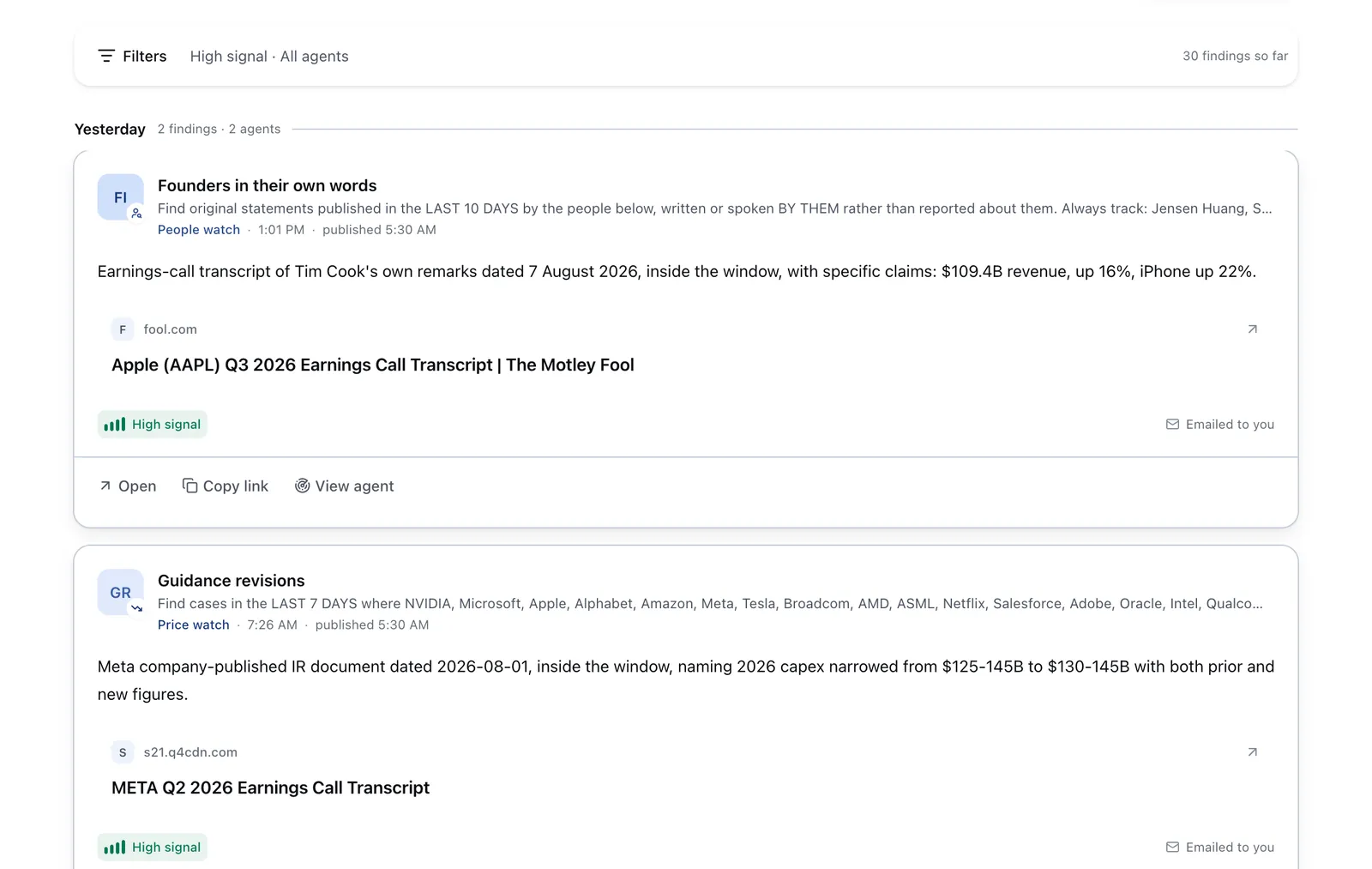
Run it on Parlel
Interviews start with discovery — and standing alerts mean you interview more while stressing less about pipeline:
agent: interview-pipeline
stages: ["applied", "round-1", "final", "offer"]
reminders: ["thank-you < 24h", "follow-up day 7"]
digest: friday 17:00 IST
Digest shape: every live process with its next action ("send a personalized thank-you within 24 hours" or "check in after the stated timeline"), so the note is not confused with an application-status chase. Track the process on the Parlel job board and retain the employer’s stated timeline.
Keep reading
Continue the workflow with three closely related guides: - how to follow up on a job application - cover letter format - how to negotiate job offer
Frequently asked questions
How soon after the interview should I send a thank-you email?
Within 24 hours is the clearest guidance. If the interview ends late or before a weekend, the next business morning is reasonable.
Should I email every panel interviewer separately?
Yes, with a distinct detail per person. Panels compare notes, and identical messages read as automation while distinct ones read as attention.
Can a thank-you email fix a bad answer?
One answer, repaired crisply in two to three lines — yes. It shows self-correction, which teams read as a work trait. Two or more repairs read as damage control.
What if I have no interviewer email addresses?
Ask the recruiter or coordinator for contacts (normal request), or send one consolidated note through them. Never guess addresses or add people on social platforms instead.
Is a thank-you email still expected in 2026?
It remains a normal professional courtesy. It may help the interviewer recall a specific conversation, but it is not required everywhere and cannot substitute for relevant experience.
Should I send a thank-you after rejection?
Yes, if you can write it sincerely. Thank them for the process, name one genuine detail, and say you would be open to hearing about a relevant future role. Do not imply that reconsideration is owed.