Applying and waiting is a strategy for silence. Here is how to follow up on job application threads the way recruiters prefer — at the right intervals, with the right scripts — a discipline that routinely doubles response rates: this guide gives you the exact timeline table, a follow-up email template for every stage, and the research habits that make each touch land.
TL;DR
- "Follow the 7-7-14 timeline: first nudge day 7, second day 14, final check-in day 28 — then move the thread to nurture, not pursuit."
- "Every follow-up must add signal, not just ask for status: a new artefact, a sharper fit line, or proof you researched the company."
- "How to check job application status without annoying anyone: one short email per interval, always with an easy out for the reader."
- "Cold email for a job works when it leads with their problem and your proof — three lines, one artefact, zero flattery."
- "After interviews, switch to the thank-you-then-wait cadence: note within 24 hours, follow-up only past the stated timeline."
The follow-up timeline table: when to nudge and when to stop
Persistence wins; pestering loses — the difference is intervals and exits. Use this table as law, adjusting only when the employer stated an explicit timeline (then add three grace days past it before nudging).
| Stage | First nudge | Second nudge | Final touch | Then |
|---|---|---|---|---|
| Cold application, no response | Day 7 | Day 14 | Day 28 + close | Nurture quarterly |
| Post-recruiter screen | Day 5 | Day 12 | Day 21 | Ask for feedback, move on |
| Post-interview round | Thank-you <24h, nudge past stated timeline +3 days | +7 days | +14 days, gracious close | Grace-note template |
| Post-final / offer pending | Per stated date +2 days | +7 days | +14 with competing-timeline honesty | Negotiate or release |
| Referral intro sent | Day 4 | Day 10 | Thank referrer regardless | Keep referrer updated |
The "close" matters as much as the nudge: a final email releasing the thread ("I'll assume timing isn't right — grateful for the consideration") paradoxically triggers replies because it removes pressure, and it preserves the relationship either way. Track every thread in one pipeline view so nothing relies on memory — our interview questions and answers bank covers what to do when follow-ups convert into rounds. Hiring-process reporting confirms most candidates never follow up even once, making a single polite nudge a differentiator (Forbes on job search).
Follow up email template: the three-touch sequence
One job application follow up email architecture serves all stages: short, warm, new information, easy exit. Here is the full sequence for a cold application — adapt brackets for later stages.
Touch 1 (day 7):
Subject: Following up — [Role] application, [Your Name]

Hi [Name],

Just floating my application for [Role] back to the top —
applied [date]. One fit line: [e.g. two years on billing
infra matching your reliability push].

Happy to share [one artefact: writing sample / dashboard /
code link] if useful. Either way, appreciate your time.

Best, [Your Name] | [phone]

Touch 2 (day 14):
Subject: Re: Following up — [Role], [Your Name]

Hi [Name],

Brief second nudge with something new: [fresh signal —
e.g. shipped X since applying / read your launch post on Y,
one genuine observation].

If the seat's filled or paused, no worries at all — just
didn't want a busy inbox to be the reason.

Best, [Your Name]

Touch 3 / close (day 28):
Subject: Closing the loop — [Role], [Your Name]

Hi [Name],

Last note from me — I'll assume timing isn't right and stop
nudging. Grateful for the consideration; if [adjacent area]
opens later, I'd welcome a look.

[Your Name] | [profile URL]
Each touch adds signal instead of repeating the ask — that is the entire art. For post-interview threads, replace Touch 1 with the thank-you note and start nudging only past the employer's stated timeline.
How to check job application status without being a pest
How to check job application status comes down to channel and framing. When you follow up on job application portals showing "under review", do not email a human to narrate the dashboard — those statuses update asynchronously, and asking irritates. Channel hierarchy for real silence: reply in the existing thread first (context preserved), recruiter or coordinator second, hiring manager last and only with new substance. Frame every check as offering, not extracting: "happy to share X if helpful" beats "any update?" because it gives the reader something to say yes to.
Include an explicit exit every time ("if paused, no worries") — exits get replies because they lower the cost of responding with bad news, and bad news with feedback beats silence. If you learn the role closed, pivot instantly to the grace note: thank them, ask to be considered for adjacent seats, and mean it. Logistics answers (notice, compensation) should be ready before these exchanges turn live — our negotiation guide prepares that half.
Follow up after interview: the thank-you-then-wait cadence
Follow up after interview follows a stricter cadence because the employer set expectations explicitly. Step one: thank-you note within 24 hours to each interviewer (templates in our thank-you email guide). Step two: silence until three days past their stated decision date — "we'll decide by Friday" means your first nudge lands Monday, referencing their timeline, not your anxiety. Step three: one nudge per week, max two, each under 100 words, each restating enthusiasm plus availability rather than demanding verdicts.
If timelines slip repeatedly, read the signal honestly: continued vague delays usually mean deprioritised headcount or a leading internal candidate. Your final touch should preserve dignity and optionality — gracious candidates get the call when the first choice declines. Meanwhile keep pipeline full; follow-up converts best when you can afford to lose any single thread.
How to research a company for an interview before you follow up
How to research a company for an interview doubles as follow-up fuel: every touch can carry one proof you did homework. The 45-minute research stack: company site and pricing page (what they sell, to whom), founder/executive posts and interviews (how they think), engineering blog or product changelog (what they are building now), recent funding or launch news (trajectory and runway narrative), employee reviews filtered for your function (what insiders flag), and the interviewer's own public work (one genuine conversation hook). One observation from this stack, deployed in a follow-up, outperforms ten generic enthusiasm lines.
Deploy findings as artefacts: a two-line take on their launch, a question about a technical decision they wrote about, a relevant sample of your work mapped to their stated problem. This is also the habit that powers cold outreach below — research once, reuse across touches. General career-playbook advice on channels and cadence is covered in our job seeker guide.
Cold email for a job: the three-line opener that gets replies
Cold email for a job works when it reads like the start of useful correspondence, not an application smuggled into an inbox. Structure: line one names their specific problem or recent work (proof of research), line two states your relevant proof in one metric (credibility), line three makes a minimal ask (a 15-minute chat, feedback on your take — never "give me a job"). Total under 120 words, subject line under 8 words naming the topic, not the demand ("Your onboarding teardown + one observation").
Subject: [Their launch] + one observation

Hi [Name],

[One specific line: e.g. your post on moving verification
post-aha-moment matched what we saw at [X] — drop-off fell
8 points when we tried it.]

I'm a [lane] with [one metric proof], exploring [their space].
Worth a 15-min chat next week? Happy to share what we learned.

Best, [Your Name] | [one link]
Target hiring managers and senior ICs, not generic inboxes; send Tuesday–Thursday mornings in their timezone; follow the same 7-7-14 table. Cold-email effectiveness data from freelance hiring shows specificity-plus-artefact outperforming credential-led openers across contexts (Golance on cold outreach), and workplace writing coverage agrees personalised brevity wins (Guardian on professional email).
Cover letter template and resignation letter template: the bookends
Two adjacent documents complete the follow-up toolkit. The cover letter template for applications needing one: paragraph one (role + one-line fit), paragraph two (two proof bullets with metrics), paragraph three (why this company specifically — one research observation), close (availability + notice period). Under 200 words; hiring managers skim, and the resume carries the weight. Full structure lives in our cover letter format guide.
The resignation letter template — for when follow-ups succeed: keep it to four lines (gratitude, last working date per notice period, handover commitment, goodwill), submit after the signed offer, and never negotiate using an offer you would not accept. Notice-period mechanics for Indian employment are detailed in our notice period negotiation guide — read it before your success creates a scheduling problem.
The job application follow up operating standard
This guide is written for a reader who needs to use job application follow up in a real workflow, not merely understand the definition. The dependable version starts with the decision that must be made, names the evidence available today, and keeps the next step small enough to complete. That is the editorial standard used throughout this guide and across the Parlel library: practical guidance should help a founder, operator, candidate, or freelancer act without hiding uncertainty behind confident language.
Decide what success means before you start
Write the result in one sentence: “After this exercise, I will know whether , and the next action will be .” For job application follow up, that sentence prevents the most common failure mode — doing more research after the useful question has already been answered. If the work concerns a person, company, role, client, or vendor, record the source and date as you go. If it concerns a template or message, define the recipient, context, and desired response before polishing the wording.
Use a small fixture rather than an abstract example. Pick three to five real records, situations, or drafts and run the method end to end. Keep one case that should succeed, one ambiguous case, and one case that should be rejected. That mix exposes whether the process can distinguish a useful signal from a convenient story. It also gives you material for a later review without pretending that a tiny sample is a benchmark.
Make the work explainable to another person
A high-quality result should survive a handoff. Another person should be able to see what was known at the time, which assumptions were made, what action was taken, and what would change the decision. For this topic, preserve the original input alongside the conclusion. Keep a short “why now” note, the owner, the due date, and the stop condition. This makes job application follow up useful in an agency-style operating system: the work is repeatable without becoming mechanical, and a reviewer can improve it without rewriting the whole process.
Quality-control pass before you ship
- Intent: Does the page answer the query implied by its title in the first screen?
- Evidence: Are current facts linked to a source, date, or clearly labeled assumption?
- Specificity: Could a reader use the checklist, script, table, or example immediately?
- Boundaries: Does the guide say when the method is a poor fit or should stop?
- Next action: Is there one useful action rather than a pile of competing calls to action?
Those checks matter more than adding another paragraph of general advice. They also protect search quality: the page earns attention by resolving the reader's problem, not by repeating job application follow up unnaturally. If the evidence is thin, say so and explain how to improve it. If the answer changes by country, role, plan, or company size, make that branch visible instead of burying it in a footnote.
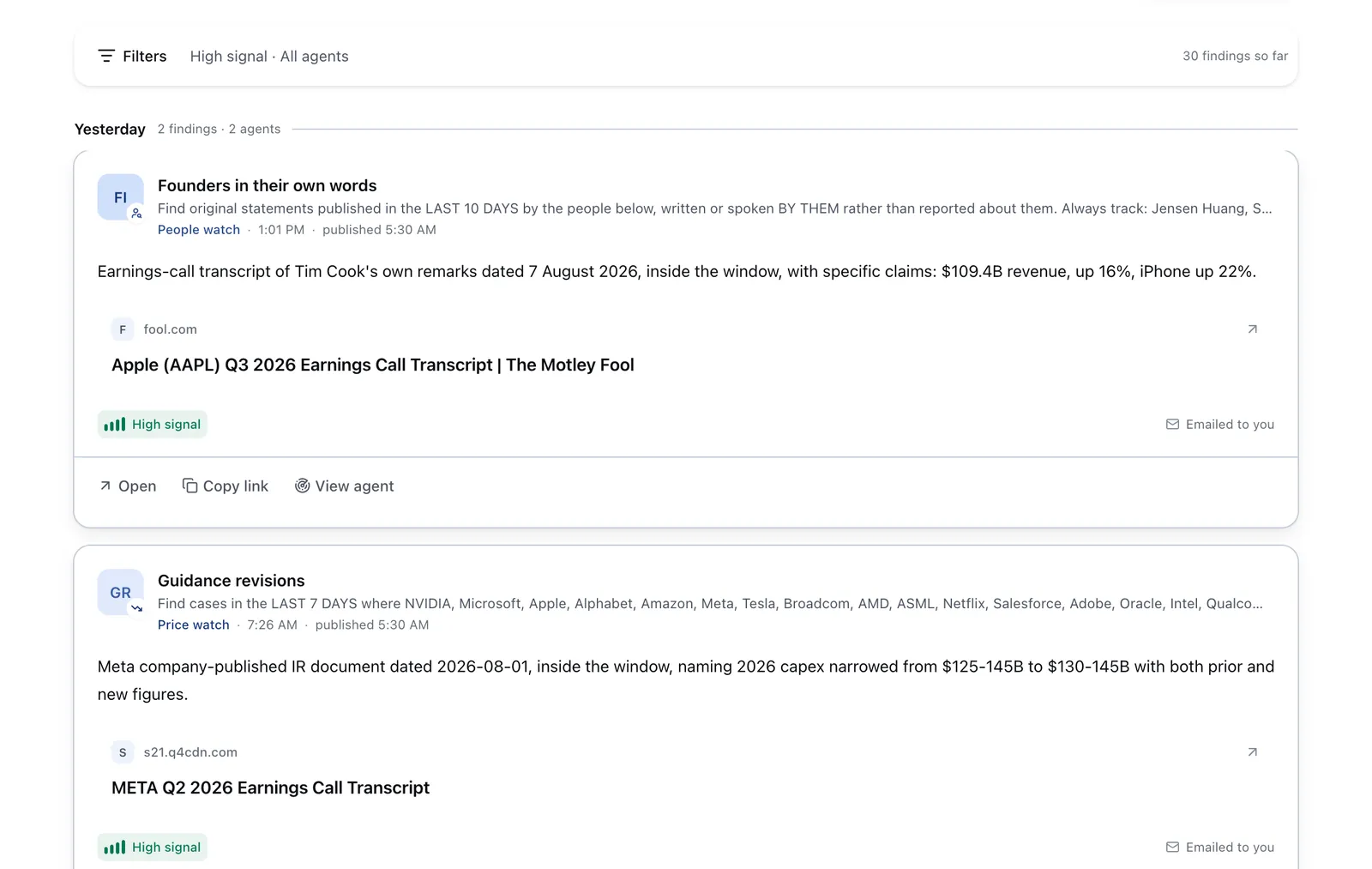
Run it on Parlel
Follow-up discipline needs a pipeline view, not memory. Run yours as a standing agent:
agent: application-tracker
threads: ["acme-backend", "beta-data", "gamma-frontend"]
reminders: ["day-7 nudge", "day-14 signal", "day-28 close"]
digest: friday 17:00 IST
Digest shape: each live thread with its next action and due date ("Acme: day-14 signal due Tuesday — attach launch observation"), dead threads auto-archived to quarterly nurture. Source new threads from the job board while old ones mature — pipeline math rewards parallel threads, and the tracker keeps every one on cadence.
Keep reading
Continue the workflow with three closely related guides: - thank you email after interview - cover letter format - interview questions and answers
Frequently asked questions
How long should I wait before following up on an application?
Seven days for cold applications, five after recruiter screens, and three days past stated timelines post-interview. Earlier reads as anxious; much later reads as disinterest.
Is it annoying to follow up twice?
No — data and recruiter testimony agree two polite, spaced, signal-adding touches are welcome. Annoyance starts at high frequency, zero new information, or demands.
What should I write if they never reply?
Send the day-28 close: release the thread graciously, invite future consideration, and move them to quarterly nurture. Dignified exits preserve relationships silence destroys.
Should I call instead of emailing?
No, unless invited. Unscheduled calls interrupt; emails respect workflow. The only exception is a recruiter who explicitly offered phone contact.
Does following up actually change outcomes?
It changes response rates substantially — most candidates never nudge once, so threads die from inbox entropy rather than rejection. A nugget of new signal per touch converts the undecided.