A B2B contact database is a searchable collection of business people and company records. Typical fields include name, job title, employer, work email, phone number, industry, location, headcount, and sometimes intent or hiring signals. It is a starting point for research, not a self-validating list.
TL;DR
- Choose a database for your actual ICP, geography, and workflow, not its advertised record count.
- Separate person coverage, current-employer accuracy, title accuracy, verified-email rate, phone coverage, and cost per usable record.
- Apollo’s official guidance currently describes 75 free credits per month and one credit for an email reveal; its pricing page separately describes trial credits. Confirm the live plan before budgeting.
- Buy a database for repeatable discovery. Use waterfall enrichment when high-value records justify multiple sources.
- Verify, document provenance, honour suppression requests, and review privacy terms before outreach.
How to evaluate one
Use a 30 to 50 account benchmark from your real market. Include an American or Indian startup-founder ICP if those are your markets, then run a separate EU/UK sample if relevant. Record the exact filters, timestamp, plan, credits, returned person, title, employer, email status, phone status, and source date.
| Metric | Definition |
|---|---|
| Person coverage | Target people returned divided by people requested |
| Employer accuracy | Returned employer matches the current public evidence |
| Title accuracy | Returned title is current enough for the use case |
| Email usability | Address passes your independent verification rule |
| Phone coverage | A usable number returned, with type and country noted |
| Cost per usable record | Spend divided by records accepted after review |
Do not collapse these into “accuracy.” A database can find the person but have an old title, or return a plausible email that a verifier marks unknown. Vendor-reported coverage and accuracy are useful questions to investigate, not independent audit results.
For a founder-led sales motion, add one qualitative field: why this person now. A current hiring event, product launch, or leadership change may make a record worth reviewing. It does not make the record accurate or establish permission to contact the person.
Database comparison matrix
| Option | Fits when | Verify before buying |
|---|---|---|
| Apollo | You want discovery, enrichment, and outbound in one workflow | Free versus trial credits, email/phone cost, sending-account restrictions |
| Specialist database | Your role or geography has unusual coverage needs | Country coverage, refresh date, title evidence, opt-out handling |
| Waterfall platform | You have valuable hard-to-find contacts | Provider order, stop rules, field-level verification, source rights |
| Public research plus finder | Volume is modest and context matters | Time per record, domain confirmation, consent and suppression process |
Apollo’s official credit guidance says email access costs one credit, phone access costs eight, and only verified emails are charged. Its September 2026 guidance describes 75 free credits per month. The official pricing page also distinguishes a free-forever Starter tier from a temporary trial. Do not combine trial allowances with recurring free-plan limits in your spreadsheet.
Cost and contract questions
Ask whether a credit is consumed on a reveal, a returned result, a saved contact, a phone number, or an export. Check duplicate handling: Apollo says reusing an already saved contact across lists does not cost the same as saving a new one. Also ask about seat minimums, annual prepayment, auto-renewal notice, API fees, CRM sync, regional taxes, and unused-credit expiry.
Calculate cost per verified usable record. A $65 seat is not cheap if most returned people are outside your market or have no sendable address. Conversely, a higher per-lookup cost may be sensible for a rare executive role worth human review. Run a monthly pilot before an annual commitment and retain enough raw output to audit the vendor.
Buy versus waterfall
Buy a database when you need fast discovery, repeatable filters, and an integrated workflow for a stable market. Use waterfall enrichment when coverage gaps or high-value records justify checking multiple providers. The waterfall adds fallback coverage but also adds setup, latency, cost, duplicate risk, and data-governance work. Compare both using the same input and the same verification rule.
For an India or EU/UK motion, test local domains, titles, country phone formats, language, and privacy expectations. A database that is excellent in the US may be less useful for Bengaluru founders, German Mittelstand buyers, or UK role naming. Ask whether “global” means records are actually sourced and refreshed there or simply available as a filter.
Database selection by job to be done
The same database can be a good fit for one motion and a poor fit for another. Make the job explicit before a demo.
| Job | Minimum useful output | Common trap |
|---|---|---|
| Build a founder list | Current company, founder role, domain, country | Counting old or duplicate entities |
| Recruit for a specialist role | Current title, location, work history, public route | Treating a title match as availability |
| Find sales contacts | Named role, company context, verified work email | Treating a reveal as consent |
| Refresh a CRM | Match key, source date, changed fields | Overwriting human edits silently |
| Research an account | Evidence sentence and public trigger | Calling an inferred field “known” |
Ask vendors to show the same five or ten records under the filters you actually need. Include a small company, a recently funded company, a multi-entity group, a non-US domain, and a title with local naming. A polished demo using familiar US companies says little about an India, EU, or niche-role motion. If the vendor cannot show evidence or status definitions, treat the database as a lead source rather than a source of truth.
Illustrative startup pilot
Illustrative example, not a reported test: A three-person founder team wants 25 contacts at seed-stage fintech companies hiring their first commercial operator. They start with company domains and public role context, then search for a current person. They score each row on employer match, title match, work-email status, location, and reason-now. A row with a perfect title but no current employer evidence stays in review; a row with a slightly different title but a current hiring signal may be more useful for research.
At the end of the pilot, the team counts accepted rows, not returned rows. It also records time spent correcting companies, removing duplicates, and researching uncertain titles. If the database produces 20 contacts but only 11 pass the team’s acceptance rule, the relevant number is 11 usable records and the total effort required to get them. That number can then be compared with a public-research-plus-finder workflow without pretending the two tools had identical strengths.
Freshness and evidence fields
Keep these fields beside every imported record where the tool permits it: matched_on, current_employer_checked, title_observed_at, email_status, source_date, country, address_type, suppression_status, and next_review. A “verified” badge without a date is not enough for a role that changes frequently. A person’s job change may be useful context, but it does not prove they are open to a sales message or a job opportunity.
For recruiting, distinguish “currently employed,” “open to work,” and “publicly listed.” A database can show the first or third and still tell you nothing reliable about the second. For sales, distinguish “decision-maker,” “influencer,” and “contactable.” Titles are clues to responsibility, not a complete buying map.
Privacy and suppression by design
Before uploading a list, define the purpose and keep only fields needed for it. Review whether the provider obtained the data lawfully, whether it permits your intended use, how opt-outs are transmitted, and how a deletion request affects backups and exports. Keep a suppression list outside the enrichment loop and check it before every new reveal. If a person asks not to be contacted, do not let a database refresh reintroduce them.
For EU and UK campaigns, involve the person responsible for privacy and document the relevant notice and objection path. For India, consider the entity, purpose, vendor processing, and cross-border handling. For US campaigns, follow applicable anti-spam rules and identify the sender. A startup does not need an enterprise stack to be careful; it needs an owner, a written rule, and an exception queue.
Failure modes
- Title lag: a contact changed jobs, but the database did not. Check the employer’s site and a recent professional profile.
- Duplicate companies: subsidiaries and old domains create repeated records. Normalize domains before enrichment.
- Role inboxes: generic emails are not named decision-makers. Route them separately.
- False freshness: a “verified” badge may describe a past check. Record the check date and independently verify before sending.
- Consent debt: a database may provide a business contact without proving a lawful basis for your campaign. Document source, notice, opt-out, deletion, and regional requirements.
The b2b contact database operating standard
This guide is written for a reader who needs to use b2b contact database in a real workflow, not merely understand the definition. The dependable version starts with the decision that must be made, names the evidence available today, and keeps the next step small enough to complete. That is the editorial standard used throughout this guide and across the Parlel library: practical guidance should help a founder, operator, candidate, or freelancer act without hiding uncertainty behind confident language.
Decide what success means before you start
Write the result in one sentence: “After this exercise, I will know whether , and the next action will be .” For b2b contact database, that sentence prevents the most common failure mode — doing more research after the useful question has already been answered. If the work concerns a person, company, role, client, or vendor, record the source and date as you go. If it concerns a template or message, define the recipient, context, and desired response before polishing the wording.
Use a small fixture rather than an abstract example. Pick three to five real records, situations, or drafts and run the method end to end. Keep one case that should succeed, one ambiguous case, and one case that should be rejected. That mix exposes whether the process can distinguish a useful signal from a convenient story. It also gives you material for a later review without pretending that a tiny sample is a benchmark.
Make the work explainable to another person
A high-quality result should survive a handoff. Another person should be able to see what was known at the time, which assumptions were made, what action was taken, and what would change the decision. For this topic, preserve the original input alongside the conclusion. Keep a short “why now” note, the owner, the due date, and the stop condition. This makes b2b contact database useful in an agency-style operating system: the work is repeatable without becoming mechanical, and a reviewer can improve it without rewriting the whole process.
Quality-control pass before you ship
- Intent: Does the page answer the query implied by its title in the first screen?
- Evidence: Are current facts linked to a source, date, or clearly labeled assumption?
- Specificity: Could a reader use the checklist, script, table, or example immediately?
- Boundaries: Does the guide say when the method is a poor fit or should stop?
- Next action: Is there one useful action rather than a pile of competing calls to action?
Those checks matter more than adding another paragraph of general advice. They also protect search quality: the page earns attention by resolving the reader's problem, not by repeating b2b contact database unnaturally. If the evidence is thin, say so and explain how to improve it. If the answer changes by country, role, plan, or company size, make that branch visible instead of burying it in a footnote.
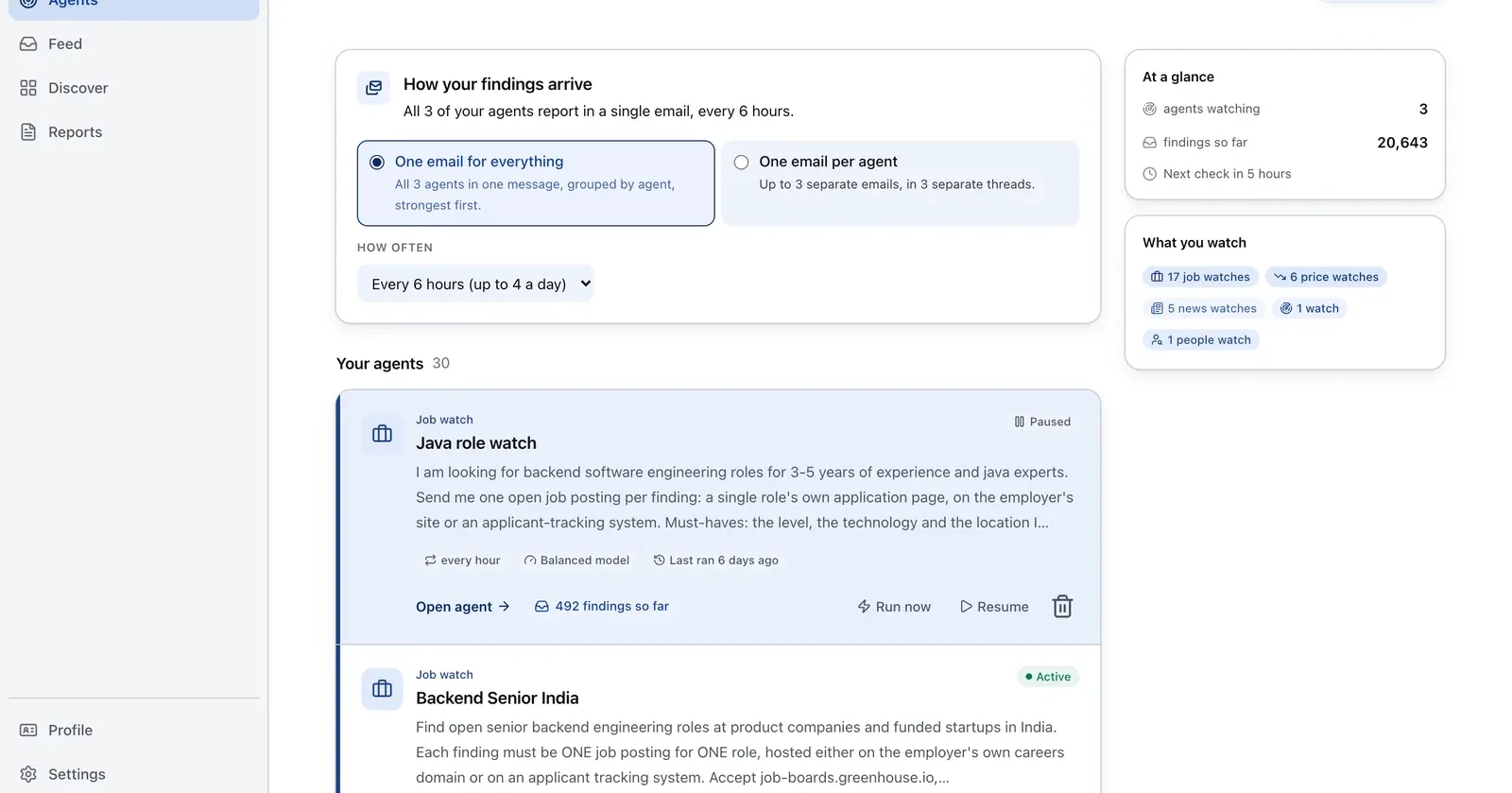
Run it on Parlel
Use Parlel to choose which accounts deserve database credits, based on a dated public role rather than a static segment.
watch: startup_hiring
filters: seed_to_seriesA, saas_or_fintech, india_or_uk
signals: first_gtm_hire, new_security_role, leadership_change
digest: monday_09:00_utc
fields: company, role, posted_at, research_priority, verification_needed
Digest: a short research queue with the role, date, and reason the account is timely. Start with explore hiring signals, enrich only the accounts your team can review, and keep source and verification fields beside each record.
Keep reading
Continue the workflow with three closely related guides: - email finder tools - crm data enrichment - clay vs apollo
Frequently asked questions
What is a B2B contact database?
A searchable index of business people and company records, usually containing titles, employers, contact paths, and firmographics. Some include intent or hiring signals. It is a discovery layer, not proof that every field is current.
Which database fits a startup?
The one that performs acceptably on your ICP, geography, and workflow. Test person coverage, current title, verified email, phone coverage, privacy controls, and cost per usable record. Do not declare a universal winner without a reproducible benchmark.
How much do B2B contact databases cost?
Models include recurring free credits, temporary trials, per-record credits, seat subscriptions, annual contracts, and custom enterprise quotes. Compare total spend and usable output, not the headline database size.
Are database records accurate and fresh?
No database is self-validating. Job changes, company moves, domain changes, and title drift all create errors. Check current employer and title, verify email, record age, and track bounce outcomes by source.
Should startups buy a database or use waterfall enrichment?
Buy for fast, repeatable discovery. Use waterfall when a hard-to-find record is valuable enough to justify fallbacks. In both cases, set a field-level acceptance rule and verify before outreach.